
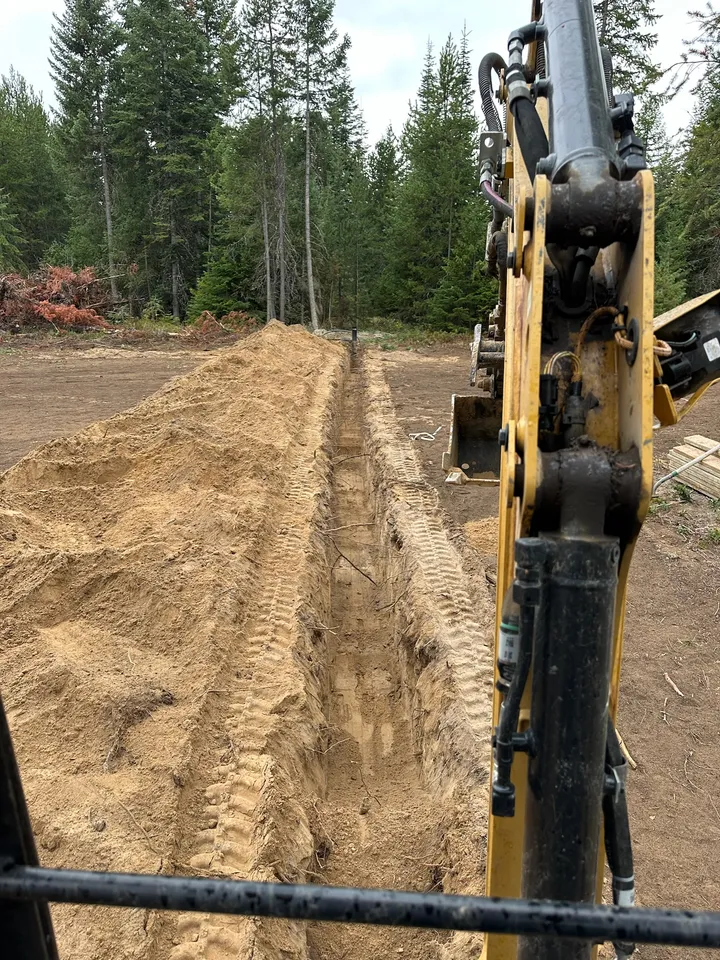
Part of new home site work: clearing, foundation, septic, utilities, drainage, and driveway as one estimate from one operator.
What we trench for
Most of our trenching is one of a short list of runs, and each has its own rules.
- Water service from the meter, the well, or the pressure tank to the house, and from the house out to a shop, barn, or frost-free hydrant.
- Power from the utility's pedestal or pole to the panel, direct-bury or in conduit, dug to the utility's specification and left open for their inspection where they require it.
- Conduit for future power, internet, or a camera run, so nobody has to dig the driveway up again later.
- Drain and sewer lines from the house to the septic tank or the sewer connection, graded with a laser so the pipe holds fall the whole way.
- Well-to-house lines and pump wire, often in the same trench as the water.
- Propane and gas lines where the supplier is installing the pipe. We dig to their spec and they run the line.
Depth: frost and the utility's specification
Frost goes deep here. A water line that is not below frost depth freezes in a cold January and splits, and you find out when the yard thaws into a spring. So water goes below frost, full stop, and deeper where a driveway or a plowed area will strip the snow cover off the ground above it. Power depth is set by the utility and by whether the run is direct-bury cable or in conduit; we dig to their specification rather than quoting inches, because it changes with the voltage and the utility. Drain lines are different again. Depth matters less than fall, so a sewer trench is graded to a slope rather than dug to a depth. When two or three utilities share a trench, the utility's rules set how far apart they sit and which one goes on the bottom, and we build the trench to make that separation possible.
Locates first: call 811
Nothing gets dug until the locates are in. Call 811 a few business days before the dig and the public utilities come out and mark their lines with paint and flags. That covers the lines the utilities own. It does not cover private lines: the run from your house to the shop, the old septic, an irrigation main, or the power to the well. Those are on you to tell us about, and if you are not sure, we probe and hand-dig near where they might be rather than find them with the bucket. Near marked lines we slow down and expose them by hand. Hitting a power line is dangerous and hitting a fiber line is expensive, and both are avoidable with a phone call.
Bedding and backfill in lifts
In river sand the spoils can go straight back on the pipe. On the benches and hillsides the spoils are cobble and rock, and a rock dropped on a water line from three feet up will crack it or wear through it in a few years. So in rocky ground we bed the pipe in sand, cover it with sand to the depth the spec calls for, then bring the native material back on top. Warning tape goes in above power. The backfill goes in lifts, each one worked with the plate compactor, so the trench does not settle after the first winter and leave a groove across the lawn or the driveway. Where the trench crosses a driveway we compact harder and bring the gravel back to grade. The last step is the surface: topsoil raked back where it was lawn, gravel where it was drive.
What drives the cost
Trenching is priced from the length, the depth, and what we are digging through. These are the specifics.
- Length of the run and the depth the utility or frost requires.
- Ground. Sand and silt near the river dig fast; cobble, hardpan, and rock on the benches take longer and may need a breaker.
- How many utilities share the trench, and the separation the utility requires between them.
- Bedding sand hauled in for rocky ground, and rocky spoils hauled out when they cannot go back.
- Crossings. Driveways, walkways, and anything else that has to be cut and put back.
- Access. A straight shot across a field is different from threading between a house, a septic field, and a well.
- Restoration: lawn, gravel, and grade put back the way it was.
When we would talk you out of it
- A run that has to cross a paved county road or a state highway. That is a bore, not a trench, and it needs a road permit and a boring contractor. We can dig the pits on either side.
- Trenching in frozen ground in the middle of winter. Ripping frost is slow, the backfill will not compact, and the trench will settle in spring. Unless a line has failed and has to be fixed now, we would wait for thaw.
- Someone who wants us to run the wire or the pipe too. We dig, bed, and backfill. The electrician, plumber, or utility installs the line and signs off on it, and that is how it should be.
What you get
- Water lines below frost, power and conduit to the utility's specification
- 811 locates called before every dig, private lines probed by hand
- Sand bedding in rocky ground so cobble never rests on the pipe
- Sewer and drain trenches graded with a laser for continuous fall
- Backfill in compacted lifts so the trench does not settle
- Conduit runs added while the trench is open, so the driveway is dug once
How it goes
- 1
Call with the plan
Tell us what is going in, from where to where, and who is installing it. If the electrician or utility has a spec sheet, send it along.
- 2
Locates and site walk
Call 811, and we walk the route once the marks are down. We look for private lines, decide where the trench crosses anything, and confirm depth and separation with the installer.
- 3
Dig and bed
We open the trench to the spec depth, clean the bottom, bed it in sand where the ground is rocky, and leave it open for the installer to lay the line and for any utility inspection.
- 4
Backfill and restore
Sand cover over the line, warning tape over power, then native backfill in compacted lifts. Lawn and gravel go back to grade and we clean up.
Questions we get on the site walk
How deep does a water line have to be buried in Newport, WA?
Below the frost line, which runs deep in this part of Washington and North Idaho, and deeper still under a plowed driveway where there is no snow cover to insulate the ground. We follow the depth your plumber or the water utility specifies for the site rather than a single number, because exposure and soil change it from one lot to the next.
Do I need to call 811 before you dig a trench?
Yes, and it is free. Call 811 a few business days ahead and the public utilities come out and mark their buried lines. We will not open ground without the marks. Private lines on your property, like the run to a shop or an old septic line, are not marked by 811, so tell us about anything you know is out there.
Can you dig a utility trench through rock?
Usually. The benches and hillsides around Newport and Blanchard have cobble, hardpan, and rock outcrops, and the mini excavator handles most of it with the right bucket and patience. Solid ledge may need a breaker or a change in the route. Rocky ground also means we bed the line in sand so nothing sharp sits against the pipe.
Can water and power go in the same trench?
Often, if the utility allows it and the trench is built with the separation they require, usually with the power at a set depth and the water line offset to one side or the other. We build the trench to their rules. Sewer lines are generally kept separate from water. Ask your electrician and the utility, and we will dig to what they say.
Do you trench from the well to the house?
Yes. The well-to-house run usually carries the water line and the pump wire together, and it goes below frost like any other water line. We coordinate with the well driller or pump installer on where the line enters the house and the pitless adapter depth at the casing so the trench lands where they need it.
Related work
Where we do this work
Utility trenching on both sides of the Washington and Idaho line: Newport, Oldtown, Spirit Lake, Diamond Lake, Cusick, Usk, Deer Park, Priest River, Blanchard, and the county roads between them. See the full service area.