
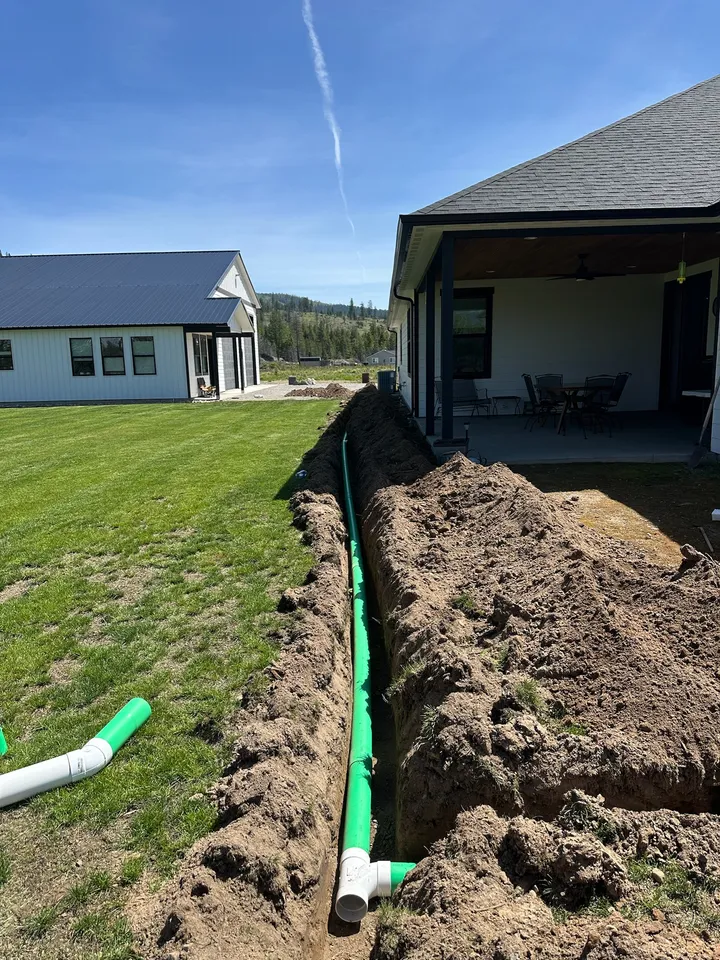
Part of new home site work: clearing, foundation, septic, utilities, drainage, and driveway as one estimate from one operator.
What we dig, and what someone else decides
A septic job has three parts and three people. The designer looks at the soil, digs or has us dig the test holes, and lays out the system: where the tank goes, how big the drainfield is, and how the effluent gets from one to the other. The health district reviews that design and issues the permit. The installer sets the tank, runs the pipe, and plumbs it. We are the excavation. That means we do not design systems and we do not pick gravity versus pressure. A gravity system needs fall, so the tank sits above the field and the pipe runs downhill. A pressure system uses a pump chamber and can push effluent uphill or a long way off, which is how a field ends up on the far side of a lot. The designer makes that call from the soil and the elevations. Either way, we dig to the drawing, and if the drawing and the ground disagree once we open it up, we stop and call the designer rather than improvise.
Digging the tank hole and the drainfield in this ground
The soil changes fast around Newport. Down along the Pend Oreille River it is sand and silt, which digs easy but caves if the hole sits open too long. Up on the benches toward Diamond Lake and Blanchard it is cobble, gravel, and hardpan, where a trench bottom has to be cleaned by hand from the bucket. On the hillsides you hit rock. The tank hole gets dug to the tank's footprint plus working room, with a flat bed at the elevation on the plan and bedding sand where the spec calls for it. Drainfield trenches are the part people rush and should not. The bottom has to be level, or at the exact fall on the design, and the sidewalls in any clay have to stay rough so they keep absorbing. We keep the machines off the drainfield area entirely, both before and after, because a compacted field is a failed field. Where the run from the house to the tank is long, we grade that trench with a laser so the pipe holds continuous fall.
Setbacks, permits, and who to call
Setbacks are the distances the system has to keep from a well, the river or lake, a property line, the house, and any surface water. They come from the permit, not from us, and they are the reason a designer sometimes has to put a field somewhere you would not have picked. On the Washington side of the line, Northeast Tri County Health District handles septic permits for Newport, Diamond Lake, Cusick, and Usk. On the Idaho side, Panhandle Health District covers Oldtown, Priest River, Blanchard, and Spirit Lake. Check with the office for your side of the line before you commit to a layout, and if you are not sure which rules apply, we will tell you on the site walk. If the septic dig is part of a new home site, the same walk covers the foundation, the driveway, and where the utilities cross so nothing lands on top of the drainfield later.
Backfill, grading, and the inspection
Nothing gets covered until it has been looked at. The health district or the installer inspects the tank, the lines, and the field with everything exposed, and only then do we backfill. Around the tank we bring the material back in lifts and work it in evenly on all sides so the tank does not shift. Over the drainfield laterals the backfill goes on with the excavator reaching out, never driving over the lines, and it is not compacted the way a driveway would be. The final grade gets a slight crown over the field and a fall away from the house, so snowmelt and spring rain shed off rather than sitting on top of the trenches. We flag the field corners before we leave so nobody parks a trailer on it, and we point out where the risers are so the pumper can find the tank in ten years.
What drives the cost
Every septic dig gets priced from the approved design and a site walk. These are the things that move it.
- The design itself: tank size and depth, number and length of drainfield laterals, and whether it is a gravity or pressure system. We dig what the drawing shows.
- Ground conditions. River sand goes fast; cobble, hardpan, and rock on the benches and hillsides take longer and dull teeth.
- Distance. A tank near the house with a field close by is a short day. A pressure field on the far side of five acres is a long trench.
- Access. Where the mini excavator and the tank truck can get to without crossing a lawn, a septic field, or a soft spot.
- Spoils. Whether the material can be spread on site or has to be hauled off.
- Replacement versus new. Replacing a failed system means decommissioning the old tank and working around the old field, which the permit will spell out.
- Season. Frozen ground in winter and mud in spring both slow the dig and the backfill.
When we would talk you out of it
- A property with no design or permit yet. We would send you to a licensed septic designer and the health district first. We can dig the test holes for the soil evaluation, but we cannot lay out the system for you.
- A system you hope just needs a clogged pipe cleared. Have a pumper or your installer diagnose it before anyone digs. Excavating a drainfield that only needed pumping is money gone for nothing.
- A layout that puts the drainfield under the driveway or where you plan to park. Talk to the designer about moving one or the other before we open the ground, because a field under traffic will fail.
What you get
- Dug to the designer's approved drawing, not to a guess
- Cat 303.5E2 mini excavator fits tight lots and established yards
- Level trench bottoms and clean sidewalls in sand, clay, and cobble
- Coordination with your installer and the health district inspection
- Backfill in lifts and a final grade that sheds water off the field
- One call for the septic dig, the water line, and the foundation on a new build
How it goes
- 1
Send us the approved design
Call or use the form and attach the design or the permit if you have it. We will ask who the installer is and whether the site is a new build or a replacement.
- 2
Site walk
We walk the tank location, the field, and the route from the house with the drawing in hand, check access for our machines and the tank truck, and confirm which health district the permit came from.
- 3
Dig and coordinate
We schedule the dig around the installer and the tank delivery, open the tank hole and lines, and cut the drainfield trenches to the plan's depth and fall. Everything stays open for the inspection.
- 4
Backfill and grade
After the inspection passes, we backfill the tank in lifts, cover the field without driving on it, and grade the surface so water runs off. We flag the field corners and clean up.
Questions we get on the site walk
Do you install septic systems or just dig for them?
We do the excavation: the tank hole, the drainfield trenches, the line from the house, and the backfill and grading afterward. A licensed septic designer lays out the system, the health district permits it, and your installer sets the tank and runs the pipe. We work alongside the installer so the dig matches what they need.
How deep does a septic tank hole or drainfield trench go?
It depends on the design. The designer sets the tank elevation and the trench depth from the soil evaluation and the fall from the house, and the permit locks it in. We dig to those numbers with a laser rather than to a rule of thumb, because a trench that is a few inches off can leave a gravity system without enough fall.
Can you replace an old septic system?
Yes. A replacement goes through the same designer and health district permit as a new system, and we dig the new tank and field to that plan. The permit also tells you how the old tank has to be decommissioned, which usually means pumping it and then removing it or filling it so nothing can collapse into it later.
What is the difference between a gravity and a pressure septic system?
A gravity system lets effluent flow downhill from the tank to the drainfield on its own, so the field has to sit lower than the tank. A pressure system adds a pump chamber and pushes effluent through smaller pipe, which lets the field go uphill or farther away. The designer picks one based on your soil and your elevations. We excavate for both.
Who issues the septic permit for Newport, WA or Priest River, ID?
On the Washington side, Northeast Tri County Health District handles septic permits for Newport, Diamond Lake, Cusick, and Usk. On the Idaho side, Panhandle Health District covers Oldtown, Priest River, Blanchard, and Spirit Lake. Check with the office for your county before you set a layout, and we will confirm which one applies when we walk the site.
Related work
Where we do this work
Septic excavation on both sides of the Washington and Idaho line: Newport, Diamond Lake, Cusick, Usk, Deer Park, Oldtown, Priest River, Blanchard, Spirit Lake, and the county roads between them. See the full service area.