
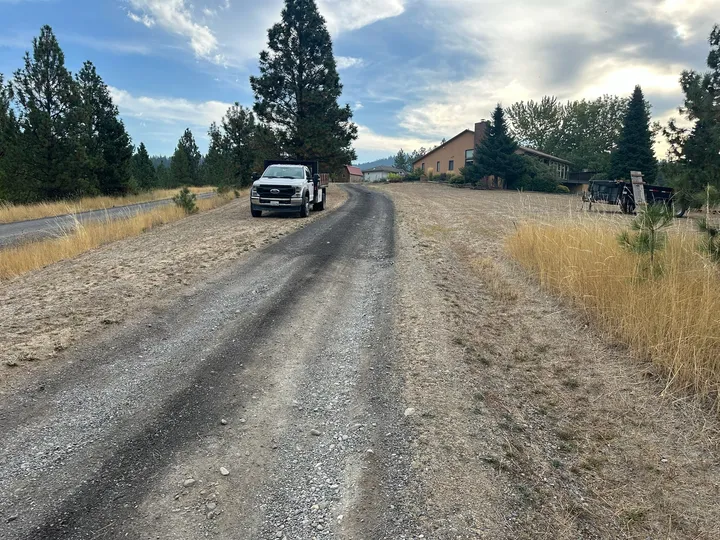
Part of new home site work: clearing, foundation, septic, utilities, drainage, and driveway as one estimate from one operator.
Cutting the road: what we do with the ground
A driveway starts with what is there. On a bench lot with cobble and hardpan, we strip the topsoil and organics down to firm ground, which may be only a few inches. On river-bottom silt near the Pend Oreille or on a wet meadow, the soft material can go deeper, and we cut until we hit something that will carry a truck, or we bridge it with geotextile fabric and a thicker lift of base. Through timber, the trees and stumps come out with the excavator and the roots get grubbed, because a stump left under the road rots and leaves a hole. Cuts and fills get balanced where we can: dirt from a high spot becomes fill for a low spot, and the road gets a steady grade instead of following every bump. Anything that will not compact, like topsoil, stumps, and wet clay, does not go under the road.
Base and crown
The base is what makes a gravel driveway a road instead of a strip of loose rock. We spread pit run or coarse crushed rock in lifts and compact each one with the plate compactor or the machine tracks before the next one goes on. The top course is a finer crushed gravel with fines in it, which locks together when it is compacted and sheds water instead of soaking it up. Both layers get built with a crown: the center is higher than the edges, so rain and snowmelt run off to the sides instead of pooling down the middle. On a hillside drive we use a cross slope toward the ditch instead of a crown. The gravel you see is the last few inches. The reason the drive does not rut is the compacted base under it.
Drainage, ditches, and culverts
Water is what kills a driveway. A ditch on the uphill side catches water coming off the slope before it crosses the road, and a culvert carries it under the drive where the ditch has to cross. Culverts get set with a fall so they do not silt up, with the ends armored in rock so the spring melt does not wash out the fill around them. Where a driveway meets the county road or the highway, the approach has to be built so it does not dump water and gravel onto the public road, and a new approach usually needs an approach permit. Check with the county road department, or the state DOT on US-2 and State Route 20, and we will tell you on the site walk what your approach looks like from their side. On long access roads we put in water bars or rolling dips so runoff leaves the road every so often instead of building up speed.
Plow season, and why driveways fail
A driveway around here gets plowed. That means the plow needs a place to push snow, the edges need to be firm so the blade does not peel the gravel off into the ditch, and any culvert ends and ditch crossings need to be marked before the first storm. We build the shoulders wide enough for a plow truck and can set stakes at the culverts. As for failure, driveways go bad for three reasons, and we see all of them every spring. No base: gravel spread on topsoil sinks into it within a year and comes back up as mud in March. No crown: a flat drive holds water in the wheel paths, the water softens the base, and the ruts grow with every trip. No ditch: runoff from the slope above crosses the road every rain and takes the fines with it, until the gravel is loose rock on bare dirt. A fresh load of gravel fixes the symptom. Building the base, the crown, and the ditch fixes the cause.
What drives the cost
We quote a driveway after walking the route. These are the things that move the number.
- Length and width. Material and compaction time scale with the square footage of road.
- Ground. Firm bench gravel needs little cut; wet meadow or deep silt needs more excavation, fabric, and a thicker base.
- Clearing. Trees and stumps to remove before the road can be cut.
- Cut and fill. A drive across a slope means moving dirt to build a bench; a flat lot barely needs it.
- Base depth and gravel type, and the distance from the pit to your site.
- Drainage: ditch length, number and size of culverts, and rock at the ends.
- Approach onto a public road, and any permit that goes with it.
- New build versus regrade. Reworking an existing drive that has a solid base costs less than starting from dirt.
When we would talk you out of it
- A few loads of gravel spread over mud to get through the winter. It will be gone by spring and you will have paid for gravel that is now part of the subsoil. If the budget only covers that, wait until it dries out and build the base once.
- A paved driveway without the base under it. We build the base and the drainage and can prep for asphalt or concrete, but we do not pave. If the plan is to pave over what is there without rebuilding the base, the pavement will crack where the base fails, and we would rather say so up front.
- A driveway that has to cross a creek, a wetland, or a neighbor's ground. Those need permits and sometimes an engineer before any machine shows up. Check with Pend Oreille County Community Development or Bonner County Planning, and we will tell you on the site walk what we can and cannot do.
What you get
- Topsoil and organics stripped so the base sits on firm ground, not mud
- Base compacted in lifts, not dumped and driven on
- Crown or cross slope built into every drive so water leaves
- Ditches and culverts sized for spring melt, with rock at the ends
- Shoulders wide enough for the plow
- Same crew builds the drive, the pad, and the trenches on a new home site
How it goes
- 1
Call or send the form
Where the drive starts and ends, what it is for, and whether it is new or a regrade.
- 2
Site walk
We walk the route with you, look at the soil and the slope, figure out where water comes from and where it can go, check the approach onto the road, and mark any trees to keep.
- 3
Written quote
Clearing, cut and fill, base depth and gravel type, ditches, culverts, approach, and how many truckloads.
- 4
Clear, cut, base, crown, drain
Trees and stumps out, topsoil stripped, road cut to grade, ditches and culverts in, base spread and compacted in lifts, top course crowned and compacted, approach finished.
Questions we get on the site walk
How thick should the gravel be on a new driveway?
A new driveway needs a base course of several inches of compacted pit run or coarse rock, then a top course of finer crushed gravel, and the depth depends on the soil under it and what will drive on it. Firm ground needs less; wet silt or a road for concrete trucks needs more. We set the depth after looking at the ground, not from a chart.
Why does my driveway turn to mud every spring?
Usually because the gravel was spread on topsoil with no base, or the drive has no crown and no ditch. Water sits in the wheel paths, softens what is underneath, and the gravel sinks. Frost makes it worse every winter. The fix is to strip the soft material, build a compacted base, crown it, and give the water a ditch to leave by.
Do I need a permit for a new driveway?
For the driveway itself on your own land, often not, but the approach where it meets a county road or the highway usually needs an approach permit. Check with the county road department, or the state DOT for US-2 and State Route 20. Crossing a creek or wetland is a separate matter. We walk through all of it on the site visit.
Can you fix a driveway that has ruts and potholes?
Yes. If there is a base under it, we scarify the surface, reshape the crown, clean the ditches, and add a top course of fresh gravel. If the ruts go all the way down to dirt, there is no base, and a regrade only lasts until the next thaw. We will tell you which one you have after walking it.
How long does it take to build a gravel driveway?
A short driveway on firm ground is a short job. A long access road through timber with ditches and culverts takes longer, mostly for the clearing and the truckloads of base. We give you a schedule with the quote, and weather can move it, because we do not build base on frozen or saturated ground.
Related work
Where we do this work
Driveways and roads on both sides of the Washington and Idaho line: Newport, Diamond Lake, Cusick, Usk, Deer Park, Oldtown, Priest River, Blanchard, Spirit Lake, and the county roads between them. See the full service area.