
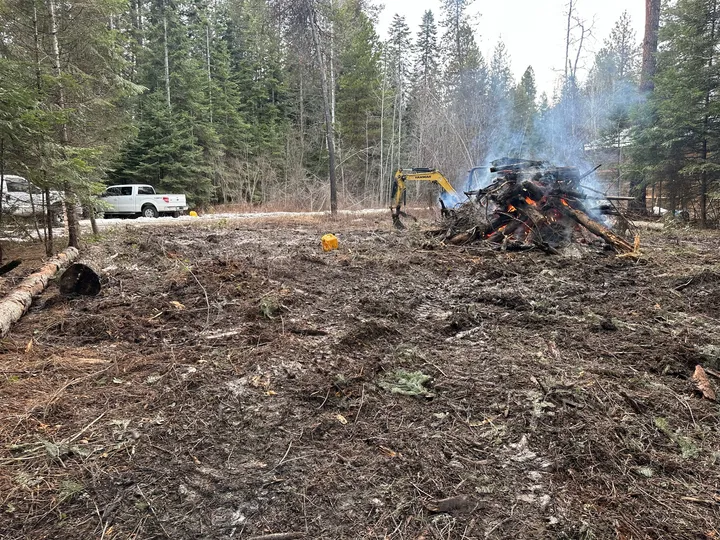
What we clear
Debris around here is mostly wood, with some concrete and a lot of odds and ends.
- Slash, limbs, and tops from land clearing or a logging job, whether we did the clearing or someone else did.
- Stumps, either pulled with the excavator or already sitting in a pile.
- Brush piles and dead trees down from a windstorm.
- Construction debris: scrap lumber, wrap, cutoffs, broken block, and the leftovers a framing crew leaves behind.
- Concrete and asphalt rubble from a demolition.
- Dirt and rock piles from someone else's dig, or spoils in the wrong spot.
- Old fence, wire, tin, and the general junk that gathers behind a shop over a couple of decades.
Burn pile or haul-off
Around Newport, Priest River, and Blanchard the cheapest way to get rid of woody debris is a burn pile, and the most reliable way is a truck. Which one fits depends on what the debris is, the season, and the rules where you live. Clean wood, slash, and stumps can usually be burned on rural ground when burning is open, which means outside the dry-season bans and with whatever permit your area requires. Construction debris, treated lumber, tires, plastic, and anything painted cannot go in a burn pile anywhere. Those get loaded and hauled. Stumps are the in-between case: they burn slowly, they need to dry out, and a big pile of them takes a season. Sometimes it is faster to haul them, or to bury them in a spot on the property where nothing will ever be built, which we only do with your agreement and well away from any future pad or drainfield. We lay out the options on the site walk with the honest cost of each.
Permits and burn season
Burning rules change by state, by county, by fire district, and by the day. The Washington side and the Idaho side do not run the same calendar, and both shut outdoor burning down in the dry months. Before anything is lit, check with your local fire district and the county, and on forested ground the state forestry office, about permits and whether burning is open that day. Nothing gets lit during a ban. What we do is build the pile right: stacked tight, clear of standing trees and structures, with the dirt pulled back around it, so it burns hot and clean when it is lit. If you would rather not deal with any of that, we haul it.
How the loads move
The track loader does the gathering. It picks up brush and slash in big bites and stacks them in one spot instead of leaving a dozen small piles across the lot. Stumps and concrete get lifted with the excavator. Loads go into the dump truck, which carries them to the transfer station, a recycler, or a wood disposal site, depending on what is in them. We sort as we go: clean wood in one load, metal in another, mixed trash in a third, because mixed loads cost more to dump. On a tight lot where the truck cannot get in, the tracked dump buggy runs debris out to the road. When the piles are gone we rake the ground and rough grade any ruts the loading left.
What drives the cost
Debris jobs are quoted from a site walk, because piles are always bigger than the photo. These are the factors.
- Volume. Slash is mostly air until it is packed in the truck, so a big loose pile can still be several loads.
- What it is. Clean brush burns cheaply; concrete, stumps, and mixed construction waste have to be hauled and paid for at the dump.
- Burn or haul. Building and tending a burn pile costs less than trucking the same material away.
- Disposal fees, which change with the material and the facility.
- Distance to the dump and how many truckloads it takes.
- Access. Piles the loader can drive to move fast; piles down a steep bank or behind a house take the dump buggy and more time.
- How clean you want it left: piles gone, or piles gone and the ground raked and graded.
When we would talk you out of it
- Household trash, appliances, or a garage full of boxes. That is a junk-hauling company or a dumpster, and they will do it cheaper than a machine and a dump truck.
- Hazardous material: old fuel, chemicals, asbestos siding, treated wood in quantity. Those need a proper disposal route, and we will tell you where to start rather than load it.
- Someone who wants a pile lit during a burn ban or without checking the rules. We will build the pile so it burns well, but the permit and the timing are on the property owner.
What you get
- One trip to clear the piles our own clearing work leaves behind
- Burn pile built right: tight, clear of trees, with a dirt ring, so it actually burns
- Loads sorted for cheaper disposal
- Stumps pulled and moved with the excavator instead of chained to a pickup
- Dump buggy for the piles the truck cannot reach
- Ground raked and rough graded when the piles are gone
How it goes
- 1
Call or send the form
Tell us what is piled, roughly how much, and whether burning is an option where you are.
- 2
Site walk
We look at each pile, sort what can burn from what has to go, and check where the truck can get to.
- 3
Written quote
Which piles burn, which haul, how many loads, and how we leave the ground.
- 4
Stack, load, haul, rake
Burn piles built and the rest loaded and hauled, sorted by material. Ground raked and ruts graded out before we leave.
Questions we get on the site walk
Can I just burn all this instead of hauling it?
Clean wood, brush, and slash, usually yes, when burning is open in your area and you have whatever permit your fire district or county requires. Construction waste, treated lumber, painted wood, plastic, and tires cannot be burned anywhere. We build the pile so it burns well; the permit and the timing are on the property owner.
Do I need a permit to burn slash?
Very often, and the rules differ on the Washington and Idaho sides and shut down during the dry months. Check with your local fire district and the county before lighting anything, and on forested land ask the state forestry office. Nothing gets lit during a ban, and we would rather haul the pile than see it become a problem.
What do you do with stumps?
Three choices. Haul them, which is reliable and costs the most. Pile and burn them, which takes a dry season because green stumps smolder for weeks. Or bury them on the property in a spot that will never carry a building or a drainfield, which we only do with your say-so. We go through all three on the site walk.
Can you clean up after another contractor?
Yes. A fair amount of our debris work follows a logger, a framing crew, or a homeowner who cleared by hand and ran out of weekends. We gather the piles with the track loader, sort them, haul or burn as the rules allow, and rake the ground. Tell us what was there and we will quote it from a site walk.
Related work
Where we do this work
Debris removal on both sides of the Washington and Idaho line: Newport, Diamond Lake, Cusick, Usk, Deer Park, Oldtown, Priest River, Blanchard, Spirit Lake, and the county roads between them. See the full service area.