
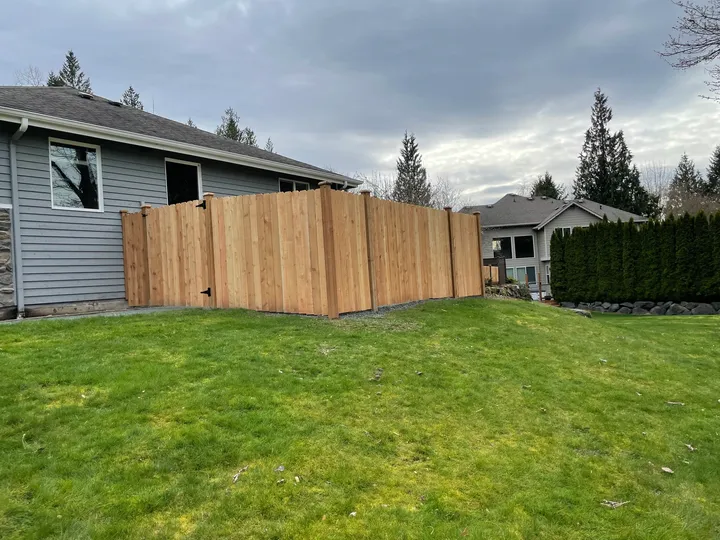
Walk gates and driveway gates
Walk gates are three to four feet wide, set into a fence line for the side yard, the garden, or the dog run. They get opened thousands of times, so the latch and the hinges matter more than the boards. Driveway gates are twelve to sixteen feet across, single or double swing, in wood to match a fence or in steel tube for a ranch-style entrance on acreage. We install manual gates. Where you might want an opener later, we set the posts and run conduit across the opening now, so adding an operator is a wiring job instead of a dig. We can also hang a gate in an existing fence, as long as the posts on either side are up to it, and we will tell you if they are not.
The post is the gate
A line post holds up a panel that does not move. A hinge post holds up a gate that swings out from it like a lever, with all the weight at the far end. So the hinge post goes deeper than the line posts, is a bigger timber or a steel post, and gets a concrete footing sized to the gate. On a driveway gate the hinge post is a different animal from anything else in the fence: heavy, deep, in a lot of concrete, and sometimes tied back to the next post so it cannot rock. Our ground makes this harder. In river sand near Newport the post needs a wider footing to keep from working loose. On the benches we dig the hole with the excavator through cobble and set it in a bigger collar. Frost lifts a shallow gate post a little every winter until the latch no longer lines up, so the post goes below frost like everything else we set.
Hardware, alignment, and sag
Gate hardware is where cheap shows. We use heavy-duty hinges rated well past the gate's weight, adjustable so the gate can be tuned after the first winter, and a latch that closes with one hand and stays closed in wind. Wide gates get a drop rod into a sleeve in the driveway and, where the span calls for it, a wheel at the free end. Sag is the common complaint, and it comes from two places: a hinge post that has moved, or a wood gate frame that has racked out of square. The frame gets a diagonal brace running from the bottom hinge corner up to the top latch corner, which is the direction that actually holds, or a cable and turnbuckle the other way that can be tightened later. We set the gate with clearance for snow and gravel so it still swings in January.
Driveway gates on a gravel drive
A driveway gate has to work with the driveway. If the drive climbs in the swing path, a swing gate scrapes when it opens and we would talk about which way it swings, a slide gate, or regrading the swing area. It has to clear the plow, and the plow driver has to be able to get past it. It needs a place for a car to stop that is not in the road. If the gate is close to the road, the county may want it set back from the right-of-way, and we will tell you on the site walk which office to check with. All of that is decided before the posts go in. Moving a driveway gate post later means digging out a lot of concrete.
What drives the cost
A gate is priced from its width, its weight, and what it hangs on. These are the factors.
- Width and type. A walk gate in a cedar fence is a small job; a sixteen-foot double driveway gate is a two-day one.
- The hinge post. Size, depth, concrete, and whether it is wood or steel, all driven by the weight of the gate.
- Ground. Sand, cobble, or rock at the post location.
- Hardware: hinge rating, latch type, drop rods, wheels, and cane bolts.
- Whether the gate hangs in a new fence, or in an existing fence where posts may need to be replaced first.
- Conduit across the opening for a future opener.
- Grade work in the swing path of a driveway gate.
When we would talk you out of it
- An automatic gate. We install manual gates and set posts and conduit so an operator can be added later, but the opener, the wiring, and the safety sensors belong to a gate automation installer.
- Hanging a heavy driveway gate on an existing line post that was never built for it. The post will move within a year and the gate will drag. We would replace the hinge post first or not do the job.
- A swing gate where the driveway climbs steeply in the swing path. We would look at reversing the swing, a slide gate, or regrading the swing area before hanging a gate that scrapes every time it opens.
What you get
- Hinge posts sized and set for the weight of the gate, below frost
- Excavator-dug post holes in cobble, with concrete footings to match
- Adjustable heavy-duty hinges so the gate can be tuned after the first winter
- Diagonal bracing or cable and turnbuckle on every wood gate
- Conduit across driveway openings for a future opener
- Swing direction, clearance, and plow access sorted on the site walk
How it goes
- 1
Call with the opening
Tell us where the gate goes, how wide, and what it is for. Photos of the fence or the driveway help. We will ask whether it is going into an existing fence.
- 2
Site walk
We check the ground at the post locations, the grade in the swing path, which way the gate should open, and whether existing posts can carry it.
- 3
Written quote
The quote lists the gate, the posts, the hardware, and any conduit or grading, so you know what you are getting.
- 4
Set, hang, adjust
Posts set in concrete and left to cure, then the gate is hung, braced, latched, and adjusted until it swings clean and closes with one hand.
Questions we get on the site walk
Why does my gate sag?
Either the hinge post has moved or the gate frame has racked out of square. A post set too shallow gets lifted by frost and tilted by the gate's weight until the latch misses. A wood gate without a proper diagonal brace slowly drops at the latch end. The fix is a deeper, heavier post and a brace that runs from the bottom hinge corner to the top latch corner.
Can you install a gate in my existing fence?
Yes, if the posts on either side of the opening can carry it. Line posts are usually fine for a light walk gate and almost never fine for a driveway gate. We look at the posts, and if the hinge post is not up to it, we replace it with one that is before we hang anything. That is a small extra cost compared to a gate that drags.
Do you install automatic driveway gates?
We install manual gates and prepare for automation: posts sized for an operator's load, and conduit run across the opening so the wiring can go in later without digging up the drive. The opener itself, its wiring, and its safety sensors are installed by a gate automation company, and we are happy to coordinate with them.
How wide should a driveway gate be?
At least twelve feet for cars and pickups, and fourteen to sixteen feet if a trailer, an RV, a delivery truck, or a plow has to get through without threading the needle. The opening should also let a vehicle stop clear of the road while the gate opens. Wider gates weigh more, so the hinge post grows with the width.
Related work
Where we do this work
Gates on both sides of the Washington and Idaho line: Newport, Diamond Lake, Cusick, Usk, Deer Park, Oldtown, Priest River, Blanchard, Spirit Lake, and the county roads between them. See the full service area.