
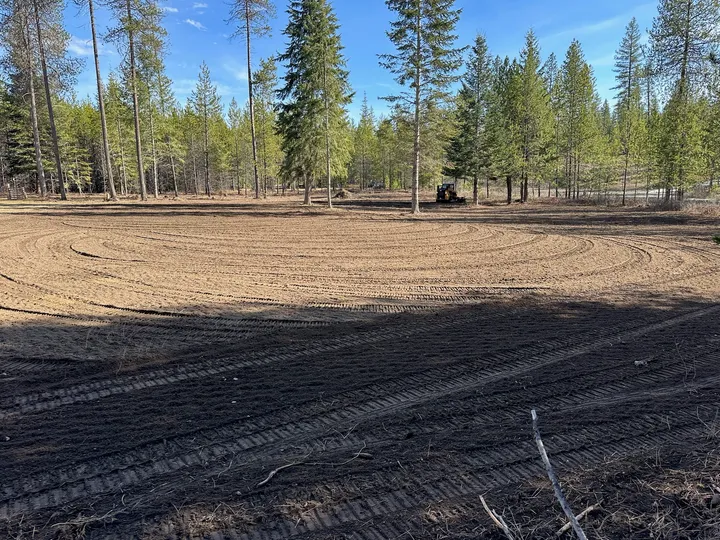
Rough grade and finish grade are two different jobs
Rough grade is the heavy work: stripping topsoil, cutting the high ground, filling the low ground, and shaping a pad or a corridor to within a few inches of the final elevation. It happens before the foundation, the driveway base, or the septic, and it is done with the excavator and the track loader moving real volume. Finish grade comes at the end, after the building is up and the trenches are backfilled. It is the last few inches: spreading the saved topsoil, setting the slope away from the foundation, feathering into the existing ground, and leaving a surface ready for gravel, seed, or sod. Skipping the rough grade and trying to fix everything at finish is how a lot ends up with a thin skin of topsoil over a hump. Doing the rough grade right means the finish grade is mostly cosmetic.
Water goes where the grade sends it
Every grading job around here is really a drainage job. The rule is simple: the ground has to fall away from the house on every side, far enough that snowmelt and spring rain end up somewhere that is not the foundation. On flat river-bottom lots near the Pend Oreille that means building the pad up so there is somewhere for water to go. On bench and hillside lots it means intercepting the water coming off the slope above the house with a swale or a cutoff ditch before it reaches the wall. We shape the grade with the spring thaw in mind, because that is when the ground is frozen a foot down, nothing soaks in, and every drop runs across the surface. If the lot already has a wet spot, a low corner, or a driveway that turns into a creek, that is where we start, and we will tell you if it needs a French drain or a swale rather than more dirt.
- Positive fall away from the foundation on all sides, carried far enough to matter.
- Swales and cutoff ditches above the house on sloped lots.
- Pads built up on flat ground so they are not the low point.
- Driveways crowned or pitched so they shed water instead of channeling it to the garage.
Cut, fill, and the balance of dirt on the lot
Leveling a sloped lot means taking dirt from the high side and putting it on the low side. The high side is easy. The low side is where grading goes wrong, because fill that is pushed in loose and left settles for years, and a pad or a driveway built on it settles with it. We place fill in lifts and compact each one, with a plate compactor or the tracks of the machine depending on the material and the depth. Native cobble and gravel on the benches make good fill. River silt and topsoil do not, and a pad that needs structural fill under it gets gravel trucked in rather than mud pushed around. The other half of the balance is volume. On a good lot the cut roughly matches the fill and nothing leaves. On a lot with too much slope, or one that needs to come up to stay out of the water, we haul material in or out with the dump truck, and that shows up as a line on the estimate.
Pads for shops, RV pads, and backyards
A lot of our grading is not for a house at all. Shop and garage pads need to be level, compacted, and built up above the surrounding ground so the slab stays dry, with the approach graded so a trailer can back in. RV pads are the same idea at a smaller scale, usually with a gravel surface and enough fall to drain. Backyard regrades are the common fix for a lawn that stays soggy, a slope too steep to mow, or a yard that sends water at the neighbor. On tight suburban lots in Newport or Deer Park the Cat 303.5E2 and the tracked dump buggy get through a gate and work around a house without tearing up the front yard to fix the back one.
What drives the cost
Grading is priced from a site walk, and the number moves with these things.
- Area, and how much elevation change there is across it. Volume of dirt moved is the main driver.
- Whether the cut balances the fill on the lot, or whether material has to be hauled in or out.
- Soil. Sand and topsoil push easily. Cobble and hardpan cut slowly, and rock is its own job.
- Compaction requirements. A pad that carries a slab needs structural fill placed in lifts, which takes longer than shaping a yard.
- Drainage work that comes with it: swales, cutoff ditches, or a French drain.
- Access. A lot we can drive onto is faster than one where every load goes through a gate on the buggy.
- Rough grade only, or rough plus finish with topsoil spread and ready for seed.
When we would talk you out of it
- A wet yard where the problem is the water table, not the grade. If the ground is saturated from below, moving dirt around on top does not fix it. We would look at a French drain or a drainage system instead, and we will say so on the site walk.
- Grading on frozen ground or in the middle of mud season. Frozen fill does not compact, and a grade set in mud shifts when it dries. We will give you a start date that matches the ground, not the calendar.
- A large commercial pad with an engineered fill spec and compaction testing on every lift. We build residential pads and shop pads to good practice; a project that needs a soils engineer on site belongs with a larger outfit.
What you get
- Grade set with a laser, not by eye from the cab
- Fill placed in lifts and compacted, so pads do not settle
- Every grade shaped to carry water away from the house
- Topsoil stripped and saved for finish grade instead of buried
- Machines sized to work behind a house without wrecking the front yard
- Honest advice when the fix is drainage, not dirt
How it goes
- 1
Call or send the form
Tell us what you are grading for: a pad, a driveway, a yard that holds water. Photos of the low spots and the slope help.
- 2
Site walk
We look at where the water comes from and where it needs to go, check the soil, figure out whether the cut balances the fill, and confirm access for the machines.
- 3
Written estimate
Rough grade, fill or haul-off, compaction, drainage work, and finish grade each priced as their own line so you can see what is what.
- 4
Grade, compact, finish
We strip and stockpile topsoil, cut and fill, compact in lifts, shape the drainage, and either hand it off to the next trade or spread topsoil and leave it ready for seed.
Questions we get on the site walk
How much slope should the ground have away from my house?
The ground should fall clearly away from the foundation on every side, and keep falling for several feet before it flattens out, so snowmelt and rain end up away from the wall rather than against it. Where a lot is flat, we build the pad up to create that fall. Where it slopes toward the house, we add a swale above it to catch the water first.
Can you level my backyard so I can put in a lawn?
Yes. Backyard regrades are a common job for us, especially on lots in Newport and Deer Park where the yard is too steep to mow or holds water. We get the mini excavator and the tracked dump buggy through a gate, cut the high side, fill and compact the low side, set the fall away from the house, and spread topsoil ready for seed or sod.
Do you compact the fill when you grade?
Yes, and it is the difference between a pad that stays where we put it and one that settles for the next three years. Fill goes in layers, each one compacted with a plate compactor or the tracks of the machine before the next goes on. Loose fill pushed in and smoothed over looks fine on day one and sinks every spring after that.
When is the best time of year for grading around Newport?
Late spring through fall, once the ground has thawed and dried out. Frozen ground cannot be graded or compacted properly, and mud season fill shifts as it dries. If you want a pad ready for a spring build, the best plan is to book the site walk over the winter and grade as soon as the lot firms up.
Related work
Where we do this work
Grading on both sides of the Washington and Idaho line: Newport, Diamond Lake, Usk, Deer Park, Priest River, Spirit Lake, Cusick, Oldtown, Blanchard, and the county roads between them. See the full service area.