
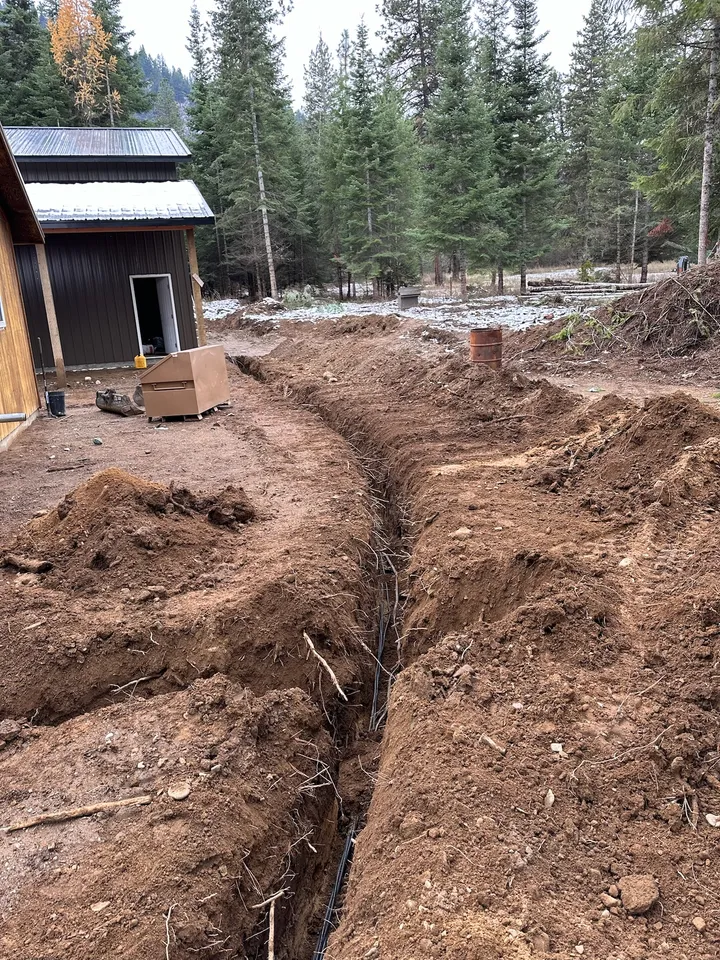
Part of new home site work: clearing, foundation, septic, utilities, drainage, and driveway as one estimate from one operator.
Why yards around here hold water
Three things cause most of the standing water we see. The first is spring thaw on frozen ground: snowmelt cannot soak in, so it runs to the lowest point on the lot, which is often the backfill zone against the foundation because that soil settled. The second is clay lenses. The benches around Newport, Diamond Lake, and Blanchard are glacial ground, and a layer of clay or hardpan a couple of feet down will hold a perched water table above it long after the surface looks dry. Dig a post hole in June and find water and you have found the lens. The third is flat river-bottom lots. Along the Pend Oreille River through Newport, Usk, and Cusick the ground is sand and silt with almost no fall, and a lot that was graded flat for a house has no way to move water off itself. Add downspouts that dump right at the foundation and a driveway that acts as a dam, and the yard fills like a bathtub.
French drains, rock swales, and downspout runs
A French drain is a trench with filter fabric, perforated pipe, and washed drain rock, sloped to an outlet. It collects water that is already in the ground and moves it. A rock swale is a shallow, rock-lined ditch across the surface that catches runoff before it reaches the house and carries it to a low corner. Downspout runs are solid pipe from each downspout to daylight, so roof water never touches the soil next to the foundation. The part that decides whether any of these work is the outlet. Every drain needs somewhere lower to discharge: a ditch, a swale, a slope, or a drywell dug into gravel. A French drain with no outlet is a long bathtub. We find the low point first and design backward from it, and we skip the fabric only when someone wants to dig the whole thing up again in five years.
Regrading and culverts
Often the cheapest and best fix is dirt. If the yard falls toward the house, we cut the high side, fill the low side, and build a fall away from the foundation so surface water leaves on its own. That is a day with the mini excavator and the track loader, and it removes the reason for the pipe. Where a driveway crosses a ditch or a swale, a culvert lets the water keep going instead of backing up and washing out the gravel. We size the pipe to the flow, bed it, and cover it deep enough that it does not crush under a truck. If the culvert sits at the road approach, the county may have rules about it, and we will tell you on the site walk which office to check with.
Water away from the foundation, and what goes wrong
The order matters. Grade first, so surface water leaves on its own. Then downspouts to daylight, so the roof is not adding to the problem. Then, if the ground is still wet, subsurface drainage to pull it down. The failures we get called to fix are almost always one of four things: a French drain with no outlet, a pipe laid without fall so it holds water instead of moving it, fabric skipped so silt filled the rock in a couple of years, or a drain installed against a foundation without fixing the grade that was sending water there. A drainage system done right is boring. The yard dries out, the crawlspace stays dry, and you forget it is there.
What drives the cost
We price drainage from a site walk, ideally when the ground is wet so we can see where the water is going. These are the factors.
- Linear feet of trench and how deep it has to be to get fall to the outlet.
- What we are digging through. River sand is fast; cobble and hardpan on the benches are slower and harder on the machine.
- Whether there is a natural outlet. A daylight outlet is cheap; a drywell is a bigger hole and more rock.
- Materials: drain rock, perforated and solid pipe, filter fabric, catch basins, and culvert pipe by diameter and length.
- Regrading. Moving dirt to build a fall away from the house is sometimes most of the job and sometimes none of it.
- Access and restoration. Getting the excavator and the dump buggy in without tearing up a finished lawn, and putting the lawn back after.
- Hauling spoils off the site when there is nowhere to spread them.
When we would talk you out of it
- A wet basement caused by a foundation crack or a failed sump pump. Exterior drainage helps, but we would want a foundation contractor to look at the wall first, or you may pay for a drain and still have water inside.
- A flat lot with a high spring water table and no low point at all. A drywell in that ground just fills up with the rest of the yard. We would talk about regrading, a sump, and a longer discharge run before we dug a French drain.
- Standing water that smells or sits over a septic drainfield. That is a failing system, which is a health district and installer problem, and a French drain next to it will make it worse.
What you get
- Grade fixed first, pipe added only where the ground still needs it
- Every drain designed from the outlet backward, so it has somewhere to go
- Filter fabric and washed rock in every French drain, laid to fall
- Downspouts piped to daylight so roof water never reaches the foundation
- Culverts sized and bedded to carry a truck and a spring runoff
- Mini excavator and tracked dump buggy for work in finished yards
How it goes
- 1
Tell us where the water is
Call or use the form. Photos from a wet day help more than anything else, because by the time we visit in July the yard may look fine.
- 2
Site walk
We find the low spot, check where the downspouts go, shoot grades, look for a place the water can leave, and dig a test hole if we suspect a clay lens.
- 3
Written plan and quote
You get a quote that says what we are doing and in what order: regrade, downspout runs, swale, French drain, culvert, or some mix, with the outlet named.
- 4
Dig, pipe, rock, grade
We trench to fall, lay fabric and pipe, place the drain rock, backfill, and finish the grade so surface water runs away from the house. Lawn areas get put back.
Questions we get on the site walk
Why does my yard flood every spring in Newport?
Snowmelt on top of frozen ground cannot soak in, so it runs to the lowest point on the lot, which is often the settled backfill against the house. On flat river-bottom lots there is no fall to carry it away, and on the benches a clay layer holds water above it for weeks. Grade, downspout runs, and a drain with a real outlet fix it.
What is a French drain and when do I actually need one?
A French drain is a sloped trench with filter fabric, perforated pipe, and washed rock that collects groundwater and moves it to an outlet. You need one when the soil itself stays saturated after grading and downspouts are fixed. If the problem is surface water running at the house, regrading or a rock swale usually solves it for less.
Can you put a culvert under my driveway?
Yes. Where a ditch or swale crosses a driveway, we set a culvert sized to the flow, bed it, and cover it deep enough to carry vehicles, then rebuild the gravel over it. If the culvert is at the county road approach, the county may have requirements for size and placement, and we will tell you which office to check with on the site walk.
Will a French drain keep water out of my crawlspace?
Usually, if the water is coming from saturated soil around the foundation and the drain has a lower outlet to discharge to. It will not fix water that enters through a crack, a bad sump, or a floor below the water table. We look at the grade and the downspouts first, because those two fixes solve a lot of crawlspace problems on their own.
When is the best time of year to install drainage?
Late spring through fall, once the ground is thawed and firm enough to work without rutting the yard. The best time to show us the problem is during thaw or a heavy rain, when the water is visible. Send photos then, and we can plan the job for when the ground will take the machine.
Related work
Where we do this work
Drainage on both sides of the Washington and Idaho line: Diamond Lake, Cusick, Deer Park, Newport, Usk, Oldtown, Priest River, Blanchard, Spirit Lake, and the county roads between them. See the full service area.