
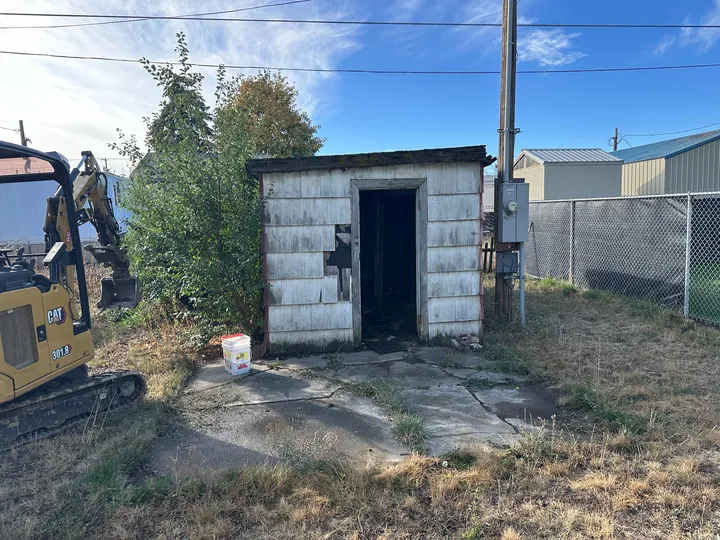
What we take down
The common jobs are the ones every rural property around Newport, Priest River, and Blanchard seems to have at least one of.
- Sheds and small outbuildings: wood-framed, metal, or block, standing or already down.
- Detached garages and carports, including the slab under them if you want it gone.
- Concrete slabs, patios, sidewalks, and old foundations or footings left from a previous building.
- Decks, porches, and stairs that are past saving.
- Block and retaining walls that have leaned over or heaved.
- Partial demolition: taking off a rotten lean-to or addition and leaving the main building standing.
- Mobile home pads, pier blocks, and the skirting and steps left after a mobile home is pulled.
Before anything comes down
Demolition is mostly planning. Before the machine touches the building we walk it with you and settle four things. First, utilities: an old shed often has a power line, a water line, or a gas line to it that nobody remembers. We call in a locate and make sure everything is disconnected or capped at the source, not at the wall. Second, what is inside: fuel cans, old paint, tires, and a freezer nobody has opened in a decade all have to come out and go to the right place. Third, what is near it: a fence, a propane tank, a well head, a septic tank lid, a tree you want to keep. We flag anything the bucket needs to stay away from. Fourth, the paper: some structures need a demolition permit, and older buildings may need an asbestos check before they come apart, especially anything with old floor tile, siding, or pipe wrap. Check with Pend Oreille County Community Development on the Washington side or Bonner County Planning in Idaho. We will tell you on the site walk whether your building is one that raises those questions.
How the machine does the work
A mini excavator takes a building down the way you would take it down by hand, only faster. Roofing and siding come off first when they need to be sorted separately. Then the walls come down inward, the framing gets stacked, and the slab or footings get broken with the bucket teeth and lifted out. Metal goes in one pile, clean wood in another, concrete in a third, and trash in the fourth, because sorted loads are cheaper to get rid of and some of it can be reused or recycled. The track loader carries piles to the dump truck, and the dump buggy handles the spots the truck cannot reach. When the structure is gone we pull the last of the footings, backfill the holes, compact, and rough grade so you are not left with a crater.
What goes wrong when demolition is done badly
The usual failures are quiet ones. Footings left in the ground under a few inches of dirt, found later by the next excavator or by a fence post auger. A live wire cut and left. Concrete buried on site to save a haul, which turns into a soft spot and a headache when someone builds there. Nails and glass left in the topsoil where kids and dogs walk. Debris burned that should never have been burned. We take the footings out, haul the concrete unless you want it crushed and kept as fill on purpose, and rake the area before we leave.
What drives the cost
We quote demolition from a site walk, and these are the things that move the number.
- Size and construction. A tin shed is a short job; a block garage with a slab is a much longer one.
- Concrete. Breaking and hauling slabs and footings is the heaviest part of most jobs, and old concrete is dense.
- What is inside and attached: contents to clear, utilities to disconnect, and anything hazardous that needs a specialist first.
- Sorting and disposal. Clean loads cost less to dump than mixed loads, and scrap metal can offset a little.
- Access. A machine that can drive up to the building works fast; a shed behind a house through a gate means the dump buggy and more trips.
- What you want left: rough grade only, or a finished pad ready for the next building.
- Permits or an asbestos survey, where they apply.
When we would talk you out of it
- A house, a commercial building, or anything with more than one story. That is a different scale of machine, permit, and disposal, and a mini excavator is the wrong tool. We will say so and can point you to a larger demolition contractor.
- A building with suspected asbestos, lead paint, or a buried fuel tank that has not been dealt with. Those need a licensed abatement or tank contractor before we can touch the structure. We can come back after.
- Someone hoping to bury the debris on site to skip the hauling. Buried concrete and wood make a soft spot that settles for years, and it can cause problems if the property ever sells. We haul it.
What you get
- Buildings come apart in pieces, sorted as they come down
- Utilities located and capped at the source before we start
- Footings pulled, not buried
- Debris sorted into metal, wood, concrete, and trash for cheaper disposal
- Holes backfilled and compacted so the spot does not sink
- Same machine and operator can grade the pad for whatever comes next
How it goes
- 1
Call or send the form
Describe the structure, what it is made of, and what is around it. Photos help a lot.
- 2
Site walk
We look at the building, the utilities feeding it, the access, and what is inside, and flag anything that needs a specialist or a permit first.
- 3
Written quote
What comes down, what gets hauled, whether the slab goes, and how we leave the ground.
- 4
Take down, sort, haul, grade
Utilities off, contents out, building down, loads sorted and hauled, footings pulled, holes backfilled and graded.
Questions we get on the site walk
Do I need a permit to tear down a shed?
Often not for a small shed, but it depends on the size, what it is attached to, and which county you are in. Check with Pend Oreille County Community Development on the Washington side or Bonner County Planning in Idaho before we schedule. Anything with old floor tile, siding, or pipe insulation may also need an asbestos check first.
Can you take out the concrete slab too?
Yes. The mini excavator breaks the slab with the bucket teeth, lifts the pieces out, and we haul them to a disposal or recycling site. If you would rather keep some as clean fill for a low spot on the property, we can do that on purpose, placed where nothing will ever be built.
Will you take down part of a building and leave the rest?
Yes, that is common: a rotten lean-to, a sagging porch, or an addition that was never built right. We cut the connection, take down the section, and leave the main building standing. We will tell you on the site walk if the part you want gone is holding up the part you want to keep.
What happens to the debris?
It gets sorted and hauled. Metal goes to a scrap yard, clean concrete to a recycler or fill site, and wood and mixed trash to the transfer station. Sorting on site keeps the disposal cost down. We do not bury debris unless you ask for clean concrete fill in a spot where nothing will be built.
Can you do the demo and then prep the pad for a new building?
Yes. The same machine that takes the old building down grades the pad for the new one. We pull the old footings, bring in and compact base if the new building needs it, and set the grade so water runs away from it. Combining the two jobs usually saves a trip.
Related work
Where we do this work
Demolition on both sides of the Washington and Idaho line: Newport, Diamond Lake, Cusick, Usk, Deer Park, Oldtown, Priest River, Blanchard, Spirit Lake, and the county roads between them. See the full service area.