
Getting there
No drive to speak of. The shop is on State Route 20 in Newport, so a site walk in town is usually the same day you call or the next morning, and the Cat 303.5E2 rides to town on a trailer behind the pickup.
Three kinds of ground inside a few miles of town
Newport sits at about 2,160 feet with the river on one side and the hills on the other, and the digging changes fast as you move between them. Down near the water the ground is river-bottom sand and silt. It digs easy and it holds water, so trenches want shoring and footings want a compacted base, and a foundation cut close to the river needs a plan for where the water goes. Up on the benches, which is where most of the newer homes around town are, the ground is glacial: cobble, gravel, and hardpan that the mini excavator handles fine but that eats a shovel. Once you climb onto the hillsides you start finding rock outcrops under a foot or two of soil, and that is where a job can turn into a hard-dig job. We walk every Newport site before we bid it because a lot that looks flat and easy from the road can be sitting on a shelf of rock, and the reverse is true too.
What the lots and homes look like here
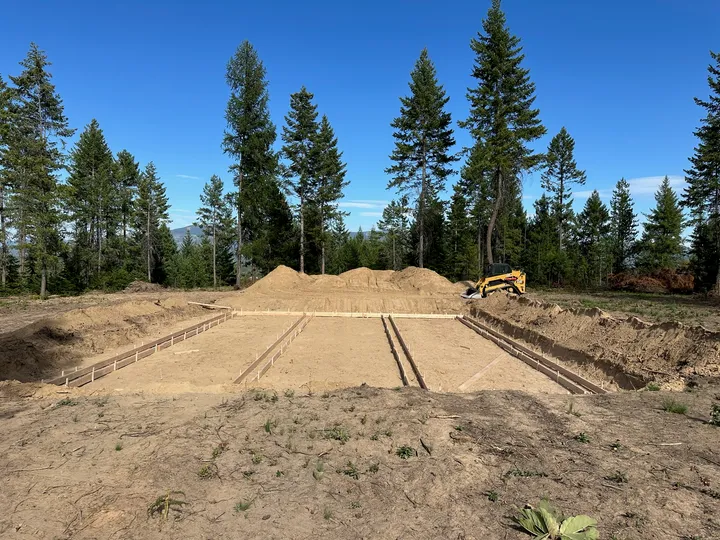
In town, Newport is an older grid of small lots with detached garages and narrow driveways that have been patched for decades. The work there is tight-access work: a mini excavator squeezed between a house and a fence to replace a sewer line, a driveway torn out and regraded so it stops draining toward the garage, a backyard leveled for a shop slab. Outside the city limits the lots get big, five to twenty acres of ponderosa pine and mixed conifer with a long gravel driveway and a septic drainfield somewhere out back. That is where we do most of our new home site work: clearing the building envelope, cutting the pad, digging the foundation, trenching the water and power, and building the driveway so a concrete truck can get up it in April.
Snow, thaw, and the river in spring
Winters here bring frost and snow, and the ground stays hard well into March on the shaded north slopes. Spring thaw is mud season. The Pend Oreille below Albeni Falls Dam is the Box Canyon reservoir, and its flows run highest in spring and early summer on snowmelt, so anything low near the river needs to be graded and drained with that in mind. We schedule the heavy grading and foundation work for when the ground has firmed up, and we use the wet weeks for the jobs that can stand a little mud: clearing, hauling, and demolition. If your lot in Newport has a low corner that turns into a pond every April, that is usually a grading problem or a missing swale, and it is fixable.
Building on a lot in Newport
Most of the new home site work we do in a year starts within a few miles of the Newport shop: a wooded lot on a bench above town, a driveway to cut, a pad to strip and grade, a foundation to dig, and the water, power, and septic lines that follow. Our site preparation page at /service/site-preparation/ walks through that sequence and how we hand a finished pad to the foundation crew. How new home site work runs, start to finish.
Permits around Newport
Newport is in Pend Oreille County. Land use, grading, and building permits go through Pend Oreille County Community Development, in the lower level of the courthouse on West 4th Street in Newport, and septic permits go through Northeast Tri County Health District. Inside the Newport city limits the city has its own rules for some work. We will tell you on the site walk which rules apply to your lot and what has to be in place before we dig.
Around Newport
- Pend Oreille River
- US-2
- State Route 20
- Albeni Falls Dam
- Box Canyon reservoir
What we do in Newport
Everything we do, on one page.
Questions from Newport
Do you work inside the Newport city limits, or only on the rural lots?
Both. In town we run the Cat 303.5E2 on tight lots for sewer and water line replacement, driveway tear-outs, and backyard grading, and the mini excavator fits through most side yards. Outside the limits the same crew handles full site prep on acreage. The bid looks different for each because access and haul distance change, but the town is our home base and we take small jobs there.
My Newport lot is close to the river. Does that change how you dig a foundation?
Yes. Near the Pend Oreille the ground is sand and silt with water close under it, so we dig with the water table in mind, shore trenches where the walls want to slough, and put drainage and a compacted base under the footings. We also look at where spring high water sits before we set the pad elevation, because the river runs highest in spring and early summer.
When does the digging season start around Newport?
Most years the ground on the sunny benches is workable by late March or April, and shaded lots and the hillsides come later. We do not cut a foundation or grade a pad in saturated ground to hit a date, because it will not compact. Clearing, hauling, and demolition can go on through the mud weeks, so we use the spring to line those up ahead of the heavy work.
Do I need a permit to grade or clear my lot in Newport?
Often, and it depends on how much you are moving and where the lot sits. Pend Oreille County Community Development handles grading and land use, and there are extra rules near the river. We will look at your lot on the site walk, tell you which office applies and what they will want, and we do not start dirt work until the paperwork that has to be in place is in place.
Nearby
We also work in Oldtown, Diamond Lake, Usk and Priest River. All the towns we cover.