
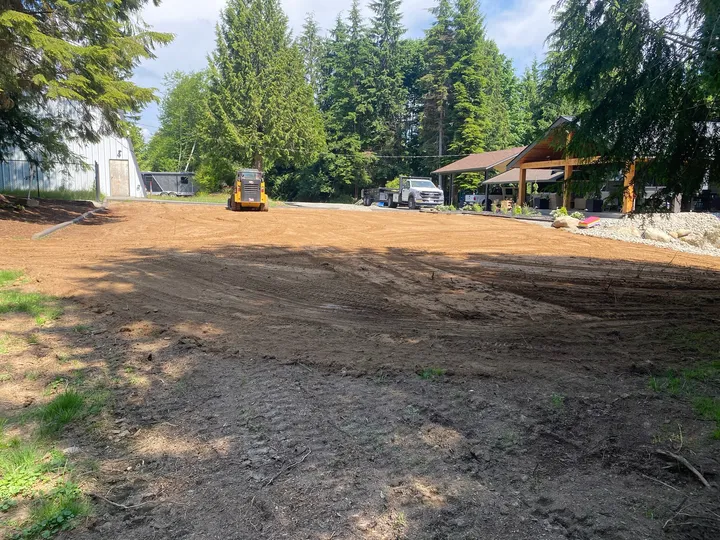
Why backfill settles
Dirt that comes out of a hole comes out fluffed. A yard of undisturbed ground is a yard and a half or more once the bucket has been through it, full of air. Push that loose material back into the hole in one lift, smooth the top, and gravity and water spend the next few years squeezing the air back out. The surface drops, sometimes a few inches, sometimes a foot over a deep trench. Around here it happens fastest in spring, when snowmelt soaks the loose fill and it slumps. That is the settling you see as a sunken strip over a water line, a low ring around a foundation that holds water against the wall, or a driveway that dips where the trench crossed it. The fix is not to wait it out. The fix is to put the air back out on purpose, before anything is built on top.
Lifts and compaction, what we actually do
Backfill goes in layers, called lifts, and each lift gets compacted before the next one goes on. How thick a lift can be depends on the material and the compactor, and it is thinner than most people expect. We run a plate compactor in trenches and around foundations, and the tracks of the loader or the excavator on larger areas where the material suits it. Material matters as much as method. Native cobble and gravel from the benches around Newport compact well. River silt and topsoil do not, and a foundation backfilled with saturated silt is a foundation with a wet, heavy load leaning on it. Where the native spoils are not suitable, we bring in gravel or structural fill on the dump truck. Moisture matters too. Fill that is bone dry or soaked will not compact, so timing and the weather are part of the job.
- Fill placed in lifts, each one compacted before the next.
- Plate compactor in trenches and against walls; machine tracks on open areas.
- Native gravel and cobble reused where it is suitable; silt and topsoil kept out of the structural zone.
- Imported gravel or structural fill where the native spoils will not compact.
Against the foundation: what goes there, and when
A foundation wall is designed to hold up a house, and only after the floor is on. Backfilling too early, before the walls have cured and before the floor framing is tying the tops of the walls together, is how a wall bows or cracks under the weight of the fill. We coordinate the backfill with your builder so the walls are ready for it. What goes against the wall matters too. The first material in the over-dig is the drain tile and washed rock at the footing, with a filter fabric over it so fines do not clog it. Above that, free-draining gravel against the wall lets water fall to the tile instead of sitting against the waterproofing, and the native spoils go outside of that. We compact in lifts on both sides of a basement so the wall is not loaded from one direction, and we keep the heavy machine off the edge of the hole where its weight would push on the wall.
Drainage away from the house, and trench backfill
The top of the backfill is the finish grade, and it has one job: carry water away from the house. Backfill settles a little even when it is done right, so we grade it high against the wall and falling away, so that after the first spring it is still sloping the right direction instead of dishing toward the foundation. The saved topsoil goes on last, over the compacted fill, so the yard grows. Utility trenches are the same idea at a smaller scale. The pipe or conduit is bedded in sand or fine material so nothing sharp sits against it, the bedding is compacted by hand, and the rest of the trench comes up in lifts. A trench that crosses a driveway gets the gravel base rebuilt over it instead of plain dirt, so the drive does not dip there. Septic tank holes are backfilled the same way, with attention to not loading the tank lid or crushing the inlet and outlet lines.
What drives the cost
Backfill is usually priced as part of the foundation dig or the trench, and these are the things that move the number.
- Volume. A full basement takes far more backfill than a crawlspace, and a long utility trench more than a short one.
- Whether the native spoils are usable, or gravel and structural fill have to be trucked in.
- Drain tile, washed rock, and filter fabric at the footing, if that is part of the scope.
- Access to both sides of the foundation and to the stockpile with the machine.
- Compaction requirements. A pad or a driveway crossing needs more attention than an open yard.
- Finish grade and topsoil spread on top, or just the structural backfill.
- Timing. Backfill has to wait on the walls and the inspections, so a return trip is often part of the job.
When we would talk you out of it
- Backfilling before the builder says the walls are ready. A poured wall needs to cure, and a basement wall needs the floor framing on before it can take the load of fill. If the schedule wants it sooner, the answer is to wait, and we will tell you why.
- Using river silt or topsoil as structural backfill because it is already on the lot. It will not compact, it holds water, and it leans on the wall. When the native material is wrong, we bring in gravel. That costs more up front and saves the wall.
- A quick fix over a trench that already sank. If loose fill has settled, topping it off with more loose fill just delays the same problem. The right repair is to dig it back out and rebuild it in lifts, and we will price that honestly.
What you get
- Fill placed in lifts and compacted, not pushed in and smoothed over
- Free-draining gravel and drain tile at the footing, native soil kept off the wall
- Backfill timed with the builder so the walls are ready for the load
- Grade set high and falling away so it still drains after the first spring
- Trenches bedded and compacted so the yard and the driveway do not dip
- Same operator who dug the hole and knows where everything is buried
How it goes
- 1
Call when the walls are close
If we dug the foundation, we are already on the schedule. If we did not, call once the walls are poured and tell us what is at the footing and where the spoils are.
- 2
Check the material and the wall
We look at the stockpile to see what is usable, confirm the drain tile and waterproofing are in, and check with the builder that the walls are ready to take fill.
- 3
Written estimate
Backfill, imported material, drain rock, and finish grade each as their own line, so you can see what the number covers.
- 4
Backfill, compact, grade
Drain rock and fabric first, then gravel against the wall, then native fill in compacted lifts on both sides, then the grade set to fall away and topsoil spread on top.
Questions we get on the site walk
Why did the ground around my new house sink?
Because the backfill was placed loose and left to settle on its own. Excavated dirt is full of air, and if it goes back in one lift instead of compacted layers, water and gravity squeeze the air out over the next few years and the surface drops. The fix is to dig the settled area out and rebuild it in compacted lifts, graded to fall away from the house.
When can you backfill a foundation after it is poured?
When the builder says the walls are ready, which is after the concrete has cured and, for a basement, usually after the floor framing is on to brace the tops of the walls. Backfilling too early is how walls bow or crack. We coordinate the date with your builder and the inspection schedule rather than working from a fixed number of days.
What material do you use to backfill a foundation?
Drain tile and washed rock at the footing, free-draining gravel against the wall, and the native spoils outside of that, placed in compacted lifts. Native cobble and gravel from around Newport work well. River silt and topsoil do not, and if that is what came out of the hole we bring in gravel for the structural zone and save the topsoil for the surface.
Do you compact the dirt when you fill a trench?
Yes. The pipe or conduit is bedded in sand or fine material and compacted by hand, then the trench comes up in lifts with a plate compactor. A trench that crosses a driveway gets the gravel base rebuilt over it so the drive does not dip. Loose-filled trenches are the sunken strips you see across yards a year after the house is done.
Related work
Where we do this work
Backfill on both sides of the Washington and Idaho line: Blanchard, Newport, Diamond Lake, Cusick, Usk, Deer Park, Oldtown, Priest River, Spirit Lake, and the county roads between them. See the full service area.