
Getting there
About 7 miles from the Newport shop, east on US-2 past Oldtown and Albeni Falls Dam. Fifteen minutes with the trailer. Lots up ID-57 toward Priest Lake add a few miles beyond that.
Two rivers, two kinds of bottom ground, and the hills
Priest River sits where the Priest River joins the Pend Oreille, so the town has river-bottom ground on two sides. That soil is sand and silt, easy to dig and quick to slump, with water close under it near either river. Foundations there get a compacted base and drainage, and trenches get shored. The benches above town and the slopes along US-2 and ID-57 are glacial ground, gravel and cobble over hardpan, which is good building ground and the kind of thing the mini excavator eats through all day. Higher on the hillsides the outcrops start, and a foundation cut on a steep Priest River lot can run into rock. We look for it on the site walk and bid a hard-dig job as a hard-dig job.
Town lots, acreage up the valley, and cabins toward the lake
In town, Priest River is an older grid of modest lots, and the work is tight-access: sewer and water line replacement, driveway tear-outs, backyard grading, a pad for a shop. Out of town the lots are acreage in the timber, with a long driveway and a septic system, and new homes there get the full site prep sequence. Up ID-57 the parcels get steeper and more remote, and the cabins that used to be seasonal are being rebuilt as year-round homes. Those jobs are about access as much as digging: a driveway that a concrete truck can climb in April, a pad benched into the slope, and drainage that carries the snowmelt around the house instead of into it.
Snowmelt, mud season, and high water
Priest River gets real winter, and the north-facing slopes up the valley hold snow and frost well into spring. When it lets go, both rivers rise on snowmelt through spring and early summer, and the bottom ground stays soft long after the roads are dry. We hold foundation and pad work until the ground firms up and use the wet weeks for clearing, hauling, and demolition. Steep lots need their drainage thought through before the pad is cut, because a driveway that channels snowmelt straight downhill will wash out its own base the first spring.
Building on a lot in Priest River
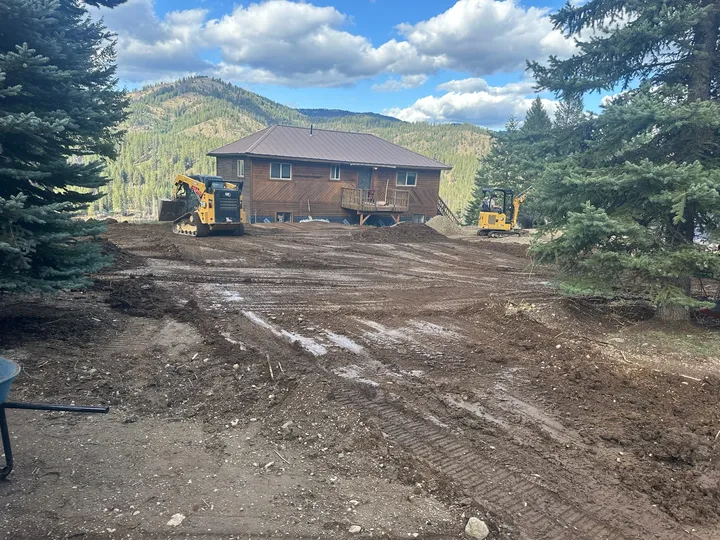
New home site work around Priest River is mostly on wooded acreage and hillside lots, where the order of operations matters: driveway and access first, then clearing the envelope, then the pad and foundation, then the utility and septic trenches, then finish grade. Our site preparation page at /service/site-preparation/ walks through that sequence and what we hand to the foundation crew. How new home site work runs, start to finish.
Permits around Priest River
Priest River is in Bonner County, Idaho. Outside the city limits, land use and building location permits go through Bonner County Planning in Sandpoint, and septic permits go through Panhandle Health District. Inside the Priest River city limits the city has its own process. Lots along either river carry extra rules. We will tell you on the site walk which office applies and what has to be approved before we dig.
Around Priest River
- Priest River
- Pend Oreille River
- US-2
- ID-57
- Albeni Falls Dam
What we do in Priest River
Everything we do, on one page.
Questions from Priest River
Do you go up ID-57 toward Priest Lake for jobs?
We do, for the lots in the first stretch north of Priest River. Those parcels are steeper and more wooded and the access takes more planning, so we walk them before we bid. Farther up toward the lake the drive time starts to matter, and we will be straight with you about whether a job that far out makes sense for us or for someone closer.
How do you cut a house pad into a steep lot near Priest River?
We bench it. The pad is cut into the slope on the uphill side and built up with compacted fill on the downhill side, with the cut material reused where it is suitable. Drainage goes in above the pad to catch what comes down the hill, and the driveway is cut at a grade a loaded truck can climb. On a steep lot the retaining and drainage are as much of the job as the digging.
Can you dig a foundation on a lot near the Priest River without hitting water?
Near either river the water table is close, especially in spring, so a deep basement is often not the right plan. A crawlspace or slab on a raised, compacted pad with drainage around it is usually the answer. We check the water on the site walk, look at what the neighbors have, and tell you what the ground will and will not support.
Nearby
We also work in Oldtown, Newport and Blanchard. All the towns we cover.