
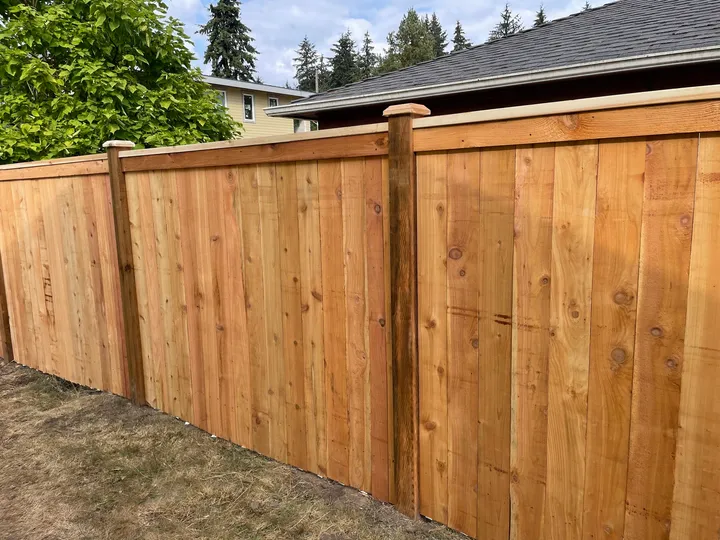
Fence styles we build
These are the fences we build most, and where each one belongs.
- Cedar privacy. Six feet tall, dog ear or flat top, boards butted tight. The standard backyard fence in Newport and Priest River, and the one snow and wind push on hardest.
- Board on board. Boards overlap on alternating sides of the rails, so there are no gaps when the cedar shrinks and the fence looks the same from both yards. Heavier, and worth it on a shared line.
- Horizontal cedar. Boards run lengthwise between posts for a cleaner, more modern look. The boards span post to post, so the posts sit closer together than on a vertical fence.
- Split rail. Two or three rails on cedar or treated posts. The right fence for a driveway line, a pasture edge, or marking a corner of acreage without closing the view. It does not hold a small dog.
- Chain link. Galvanized or black vinyl coated, in the heights that make sense for a yard, a dog run, or a shop lot. Least expensive per foot that actually contains something.
- Welded wire on posts. Wire panels or rolled wire on cedar or treated posts, sometimes with a top rail. The acreage fence around here: keeps dogs in, keeps most of the neighbor's livestock out, and disappears against the trees.
Setting posts in this ground: rock, cobble, and frost
The ground decides how the posts go in. Down by the Pend Oreille River the sand digs easy and holds a post poorly, so we go deeper and use a wider footing. On the benches around Diamond Lake and Blanchard the auger hits cobble and walks off, and we switch to digging the hole with the excavator bucket, which is one advantage of a fence outfit that owns one. On the hillsides you hit rock, and then the choice is a pin, a shallower hole with a bigger concrete collar, or moving the post a foot. Frost is the other factor. A post that does not go below frost depth gets lifted a little every winter until it leans. We set posts below frost, with gravel at the bottom of the hole so the end of a wood post is not sitting in water, and concrete or tamped gravel around it depending on the fence and the soil. Cedar posts or ground-contact treated posts, and never a fence board touching dirt.
Property lines: you confirm the line, we build to it
We do not locate property lines. You find the survey pins or have a surveyor set them, decide how far inside the line you want the fence, and we build to that. A fence a few inches over the line is a problem you will inherit at closing, and pulling it back later costs more than the survey did. It is also worth a conversation with the neighbor before the posts go in, even when the fence is entirely on your side; most fence disputes we hear about started with a surprise. We call 811 for locates before we dig post holes, because a fence line often runs right over the water service or the power to the shop.
What goes wrong with a cheap fence
The failures are predictable. Posts set too shallow, so frost heaves them and the fence goes wavy in three winters. Posts set in a concrete collar with no gravel under them, so the wood sits in a cup of water and rots off at grade. Rails spanning too far between posts, so they sag under snow. Six-foot privacy panels on an open ridge with wide post spacing, so the first wind off the river lays a section down. Gates hung on ordinary line posts. Boards run to the ground where they soak up snowmelt every spring. Each of those saves a little money on the day of the build and costs a lot more inside ten years. We build the fence to be standing when you sell the house.
What drives the cost
We measure the line and walk the ground before we quote. These are the things that move the price.
- Linear feet, and the style. Split rail and welded wire are the least per foot; board on board and horizontal cedar are the most.
- Height and post spacing. Taller fences and horizontal boards need more posts closer together.
- Ground. Sand digs fast; cobble, hardpan, and rock mean bucket digging or pinning, which takes longer.
- Gates. Each gate is its own small project with heavier posts and hardware.
- Corners and grade changes. A fence that steps or racks down a slope takes more layout and more cuts than a straight run on flat ground.
- Old fence removal and haul-away, when there is one.
- Materials: cedar versus treated, coated versus galvanized wire, and lumber prices at the time.
- Access. Whether we can get the machine to the fence line or have to carry everything through a gate.
When we would talk you out of it
- A privacy fence tight to a property line with no survey pins found. We would send you to a surveyor first. It costs less than moving a fence.
- Fencing a large pasture for cattle or horses. We build yard and acreage fence, not miles of hi-tensile or woven wire ag fence. A farm fencing outfit will do that better and cheaper.
- A fence meant to hold back a slope or hide a drainage problem. Boards do not retain dirt and posts in wet ground rot. We would look at a retaining wall or drainage first and put the fence on top of a fixed grade.
What you get
- Posts set below frost with gravel under the post so the end can drain
- Excavator bucket for post holes in cobble and rock where an auger fails
- Cedar or ground-contact treated posts, and boards kept off the dirt
- Closer post spacing on privacy and horizontal fences where wind and snow load them
- 811 locates called before the first hole
- Gate posts sized for the gate, from the same crew that builds the fence
How it goes
- 1
Call or send the form
Tell us the style, the rough length, and what the fence is for. Photos of the line help. We will ask whether the property pins are marked.
- 2
Site walk and measure
We walk the line with you, measure it, check the ground and the grade changes, note where gates go, and talk through post spacing and style for the wind and snow the site gets.
- 3
Written quote
The quote lists the style, height, post type and spacing, gates, and any removal, so you can compare it with anyone else's line by line.
- 4
Build
Locates, layout with string lines, post holes dug and posts set plumb, then rails, boards or wire, gates, and hardware. We haul off the scrap and leave the yard clean.
Questions we get on the site walk
How deep do you set fence posts in Newport, WA?
Below frost depth, which is deep here, and deeper for a six-foot privacy fence or a gate post than for a split rail line. The exact depth depends on the fence, the soil, and whether we hit rock. We put gravel in the bottom of the hole so the post end drains, then concrete or tamped gravel around it depending on the fence and the ground.
Do I need a survey before you build a fence?
If the fence goes near a property line, yes, or at least found and flagged survey pins you are confident in. We build to the line you confirm, and we do not locate property lines ourselves. A fence built over the line has to be moved, and that costs far more than a surveyor does.
What kind of fence works best on acreage around Priest River?
Welded wire on cedar or treated posts, sometimes with a top rail, for anything you need to keep in or out. Split rail where you just want to mark a line or a driveway and keep the view. Both handle uneven ground, both go up faster than board fence, and both look right against pines.
Should fence posts be cedar or treated?
Either works if the post is kept out of standing water. Cedar looks better with cedar boards and resists rot on its own. Ground-contact treated posts are cheaper and last a long time below grade. On a privacy fence we usually match the boards; on wire and split rail we often use treated posts and cedar rails.
Can you build a fence in winter?
Sometimes, on a mild stretch when the frost is shallow, but it is slower and the holes are harder to dig and to backfill well. Spring through fall is the season. If you want a fence before summer, get on the schedule in late winter so the posts go in as soon as the ground thaws.
Related work
Where we do this work
Fences on both sides of the Washington and Idaho line: Newport, Diamond Lake, Cusick, Usk, Deer Park, Oldtown, Priest River, Blanchard, Spirit Lake, and the county roads between them. See the full service area.