
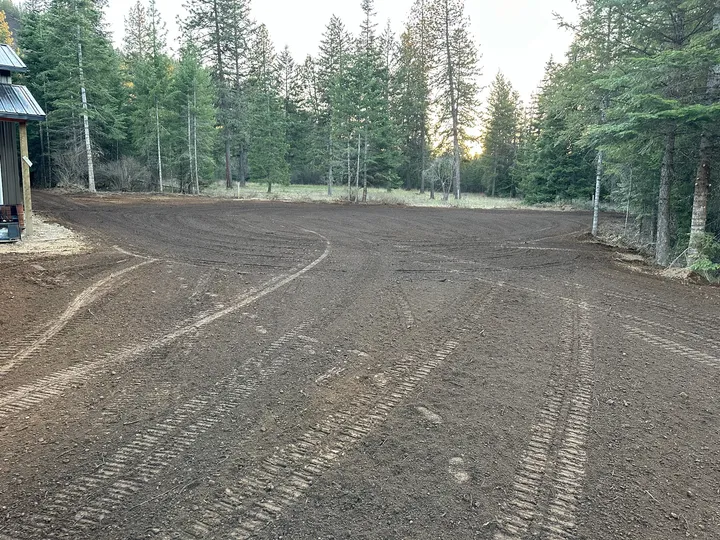
Part of new home site work: clearing, foundation, septic, utilities, drainage, and driveway as one estimate from one operator.
Brush, trees, stumps, and slash: what comes out and how
Clearing is four jobs stacked on top of each other. Brush and small trees come out first, pushed and piled with the compact track loader. Larger timber is dropped, limbed, and bucked, and the logs are either decked for you to keep, sold, or hauled, depending on what you want and what the wood is worth. Then the stumps. We pull stumps with the Cat 303.5E2 rather than grinding them, because a ground stump leaves the root ball in the ground, and a root ball under a building pad or a driveway rots and settles for years. Pulling gets the roots out, and the holes get filled and compacted. Last is the slash: limbs, tops, brush, and root wads. It gets raked into piles, and what happens to the piles is the next section. We clear the building envelope, the driveway, and the septic area to bare dirt, and we leave the rest of the trees standing unless you ask for more. A lot with the timber left around the edges is warmer in winter, shaded in summer, and worth more.
Burn piles or haul it away
There are two ways to get rid of slash, and the right one depends on the lot, the season, and the county. Burning is the cheaper option on rural acreage with room for a pile away from the trees and the neighbors. We build the piles so they will actually burn, which means stacked rather than heaped and left to sit until they are dry, usually into late fall or winter when the fire danger is down. Hauling is the answer on small lots, in town, near a shoreline, or anywhere a pile cannot safely sit, and it goes out on the dump truck to a facility that takes green waste. Stumps and root wads are the hardest thing to burn and the bulkiest thing to haul, so on a lot with a lot of big stumps we talk through the options before we start. Either way, the slash does not get buried on the lot. A buried slash pile under a driveway or a yard rots, settles, and leaves a hole a few years later.
- Burn piles: stacked, set back from the trees, and left to dry before they are lit.
- Hauling: loaded on the dump truck and taken to green waste disposal.
- Logs: decked on site for firewood or lumber, or hauled, your call.
- Nothing buried. Slash and stumps under a pad or a driveway settle for years.
County rules that commonly come into play
Clearing is one of the jobs where the rules vary the most from one lot to the next, so we do not quote thresholds here. These are the things that most often come up, and who to check with. On the Washington side, Pend Oreille County Community Development handles land use and grading, and clearing near the Pend Oreille River, a creek, or a wetland can bring critical area and shoreline rules into it. On the Idaho side, Bonner County Planning handles land use, and lots near the river or the lakes have similar setbacks. Burn piles need whatever burn permit the county or the local fire district requires, and burn bans go on during fire season regardless of permits. Clearing for a septic drainfield has to match the health district's approved design, which is Northeast Tri County Health District in Washington and Panhandle Health District in Idaho. We will tell you on the site walk which of these apply to your lot, and what to check before we bring a machine out.
Fire season, and clearing for defensible space
Every lot with a forest edge has a fire season, and it changes how clearing gets scheduled. During the dry months, burn bans are common, equipment work in dry grass can be restricted, and the piles we build sit until fall. That is not a problem if it is planned for; it is a problem if you expected the slash gone in August. A lot of clearing calls we get are not for a building at all. They are for thinning brush and ladder fuels back from a house, opening up the drive so a fire truck can get in and turn around, and getting the dead and downed material off the ground. That is the same machine work as a site clear, done with a lighter touch and a lot more trees left standing. We can do it as its own job or fold it into the clearing for a new home site so the lot is defensible the day the house is done.
What drives the cost
Clearing is priced from a walk through the timber, and these are the things that move the number.
- Area to be cleared, and how much of it is big timber versus brush and saplings.
- Stump count and size. Pulling a dozen mature pine stumps is a different day than clearing brush.
- Slash disposal: burn piles on site are the cheaper path; hauling green waste on the dump truck costs more.
- Whether the logs have value you want kept, or need to be hauled off.
- Slope and access for the loader and the excavator, and whether the dump truck can get to the piles.
- Rules on the lot: shoreline or critical area setbacks, burn permits, and fire season timing.
- What comes next. Clearing that leads straight into grading and a foundation dig is usually cheaper as one job than as two.
When we would talk you out of it
- A logging job. If the lot has enough merchantable timber that the wood is the point, you want a logger with a processor and a log truck, and then us for the stumps and the cleanup after. We will tell you on the walk if that is what you have.
- Clearing every tree off the lot. We will do it if you insist, but a home site with the timber left around the edges is warmer, shaded, and worth more, and the county may have something to say about a clear-cut near the river anyway.
- Slash disposal in the middle of fire season. Piles can be built any time, but they cannot be burned during a ban, and hauling everything to avoid the wait costs more. If the timing is fixed, we plan for it up front.
What you get
- Stumps pulled with the roots, not ground and left to rot under the pad
- Building envelope, driveway, and septic area cleared to bare dirt
- Timber left standing at the edges unless you want it gone
- Burn piles built to burn, or slash hauled, whichever the lot and the season call for
- Nothing buried on the lot to settle later
- Same machines and the same operator go straight into grading and the foundation
How it goes
- 1
Call or send the form
Tell us where the lot is and what you are clearing for: a house, a shop, a driveway, a view, or fire safety. If there is a site plan or a septic design, send it so we clear the right spots.
- 2
Walk the timber
We walk the lot with you, flag what stays and what goes, count the stumps, look at where the piles can go, and check for anything near water that brings setbacks into it.
- 3
Written estimate
Clearing, stump removal, and slash disposal each priced as their own line, with the burn or haul choice spelled out, so you can see what changes if you change the plan.
- 4
Clear, pile, and finish
Brush and trees come out, stumps are pulled and the holes filled, slash goes to piles or the truck, and the cleared area is left rough graded and ready for the next phase.
Questions we get on the site walk
Do you remove the stumps when you clear land?
Yes. We pull stumps with the excavator so the root ball comes out with them, then fill and compact the holes. Grinding leaves the roots in the ground, and roots under a pad, a driveway, or a septic drainfield rot and settle for years. Pulling costs more per stump but it is the only way to get ground that stays put.
Can you burn the brush and slash on my property?
On most rural lots, yes. We build the piles set back from the trees and stacked so they will burn, and they sit until they are dry and the fire danger is down. Burning needs whatever permit the county or fire district requires, and it stops during burn bans. On small lots, in town, or near water, we haul the slash out instead.
Do I need a permit to clear my lot near Newport?
It depends on the lot, so check before you start. In Pend Oreille County, Community Development handles land use and grading, and clearing near the river, a creek, or a wetland can bring critical area rules into it. In Bonner County it is Planning. Burn piles need their own permit from the county or fire district. We will tell you on the site walk which offices to call.
How much of the lot should I clear for a new house?
Usually the building envelope, the driveway corridor, and the septic drainfield area, plus enough room around the house for the crews to work and for defensible space from the trees. That is often a fraction of the lot. Leaving the rest of the timber standing keeps the property shaded, sheltered, and worth more, and it keeps you out of most of the county's clearing rules.
Can you clear brush back from my house for fire safety?
Yes. Thinning brush and ladder fuels back from a house, opening the driveway for a fire truck, and getting dead and downed material off the ground is the same machine work as a site clear, done with a lighter touch. We can do it on its own or as part of the clearing for a new build so the lot is defensible when the house is done.
Related work
Where we do this work
Clearing on both sides of the Washington and Idaho line: Cusick, Priest River, Newport, Diamond Lake, Usk, Deer Park, Oldtown, Blanchard, Spirit Lake, and the county roads between them. See the full service area.