
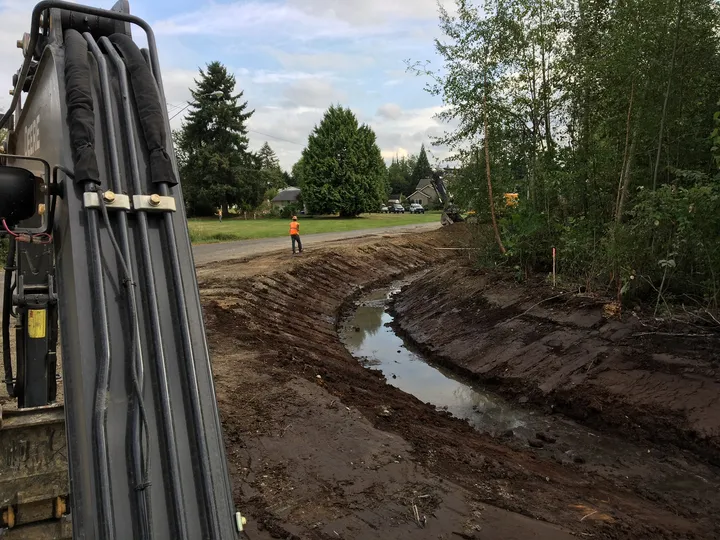
Cobble, hardpan, and rock are three different problems
People say rock when they mean anything the shovel bounced off, and the difference matters because each one digs differently. Cobble is rounded glacial stone, from fist size to head size and sometimes larger, packed in gravel and sand. It digs, but slowly, and it does not hold a trench wall, so trenches through cobble get wider than planned and the spoils are useless as bedding. Hardpan is a cemented layer, usually a foot or two down on the benches, that a bucket skids across. It breaks up with the right teeth and a ripper, and once it is broken it comes out fine, but the first pass is the slow one. Rock is bedrock or boulders too large to lift, and it is the only one that stops a mini excavator. On the hillsides it shows up as outcrops you can see, and as boulders you cannot see until the bucket finds one partway down a foundation cut. We probe for all three on the site walk, because each one changes the machine, the day count, and the number on the estimate.
When the 303.5 is enough, and when it is not
The Cat 303.5E2 with a good bucket and a ripper tooth handles cobble and hardpan on most residential jobs. It is slower than sand, and we price that time honestly, but it gets through. What it will not do is break bedrock or move a boulder the size of a car. When the probe or the first day in the hole finds solid rock inside the footprint, there are two ways forward, and we will tell you which one we recommend and why. One is a hydraulic breaker on an excavator, which chips rock out a piece at a time and works well for a footing trench, a utility trench, or a corner of a foundation that lands on an outcrop. The other is a larger excavator for that phase, which is the answer when the whole footprint is in rock or the boulders are too big for a mini to lift. For those phases we bring in the equipment the job needs rather than pretending a small machine can do it, and that shows up as its own line on the estimate. Blasting is rare on residential work here and is a specialty we would refer out.
- Cobble and hardpan: the 303.5E2 with a ripper tooth, slower but done in house.
- Rock in a trench or a corner: a hydraulic breaker for that section.
- Rock across the whole footprint or boulders too big to lift: a larger excavator for that phase.
- Blasting: referred out, and rarely needed on a home site.
Why hard-ground estimates come after a site walk
A foundation dig in sand can be priced from the plans. A dig on a bench or a hillside cannot, because the ground under the topsoil is the whole question. On the site walk we probe the footprint and the trench routes with a bar, look at any cuts or outcrops nearby, and ask what the neighbors hit. Sometimes the answer is clear: hardpan at eighteen inches, the same as every lot on that bench. Sometimes it is not, and the estimate says so, with a price for the dig as expected and a stated rate or a separate line for rock if we find it. What we do not do is quote a soft-ground number to win the job and then hand you a surprise on day two. Hard ground is normal here, it is priced as normal here, and the estimate is built so you know what changes if the bucket hits something. Corey walks every hard-dig lot himself before a number goes on paper.
What happens to the rock
Rock that comes out of a hole around Newport rarely leaves the lot, because it is useful. Cobble and broken rock make good driveway base and drainage fill. Larger boulders become retaining walls, rock swales, and the edge of a driveway cut, which is why a few of the retaining walls you see along drives in this area are built from what came out of the foundation hole behind them. Hardpan, once it is broken up, compacts back down and works as structural fill where the water can drain through it. What has no use on the lot goes out on the dump truck. On a tight suburban lot the tracked dump buggy moves rock out through a gate one load at a time, which is slow, and that is a factor in the estimate too. Sorting the rock as it comes out, so the good material is stockpiled and the waste is hauled, is part of the job rather than something we clean up at the end.
What drives the cost
Hard-ground work is priced from a site walk with a probe bar, and these are the things that move the number.
- What the ground actually is: cobble, hardpan, boulders, or bedrock, and how deep it starts.
- How much of the footprint or the trench route is in it. One corner on an outcrop is different from a whole basement in rock.
- Whether the 303.5E2 can do it with a ripper, or a breaker or a larger excavator has to come in for that phase.
- Depth. A footing trench in hardpan is one thing; a full basement in it is a lot more machine hours.
- What happens to the rock: reused on the lot for base and walls, or hauled off.
- Access. Getting a larger machine or a dump truck to a hillside lot, or moving rock out through a gate on the buggy.
- How the estimate is structured: a fixed price where the ground is known, or a base price plus a stated rate for rock where it is not.
When we would talk you out of it
- A site that needs blasting. Bedrock across an entire footprint, or a road cut through a ledge, is a job for a blasting contractor and a large excavation outfit. We will tell you that on the site walk rather than spending three days chipping at it.
- A hard-dig estimate from the plans alone. If someone gives you a firm number for a hillside foundation without walking the lot and probing it, the number is either padded or a surprise waiting to happen. We do not price hard ground without seeing it.
- Moving the house to avoid the rock, when the rock is the best bearing on the lot. A footing on solid rock is the best footing there is. Sometimes the right answer is to dig the corner that hits rock, set the footing on it, and leave the plan alone. We will say so if that is what we see.
What you get
- Probed on the site walk, so cobble, hardpan, and rock are priced before the dig, not after
- Cobble and hardpan handled in house with the 303.5E2 and a ripper
- A breaker or a larger machine brought in for rock, as its own line on the estimate
- Rock sorted as it comes out and reused for base, drainage, and walls where it fits
- Trenches through cobble bedded properly so the pipe is not sitting on stone
- Corey walks every hard-dig lot before a number goes on paper
How it goes
- 1
Call or send the form
Tell us where the lot is, what you are digging for, and what you already know about the ground. If a neighbor hit rock, or a previous dig stalled, say so.
- 2
Site walk with a probe bar
We probe the footprint and the trench routes, look at any cuts and outcrops on and around the lot, and figure out whether this is cobble, hardpan, or rock, and how deep.
- 3
Written estimate that says what it assumes
A fixed price where the ground is known, or a base price plus a stated line for rock where it is not, with the breaker or the larger machine shown separately so you can see what triggers it.
- 4
Dig, sort, and finish
We dig with the right machine for each phase, sort the rock for reuse or hauling as it comes out, and hand off a hole or a trench at the depth and grade the plan calls for.
Questions we get on the site walk
What counts as hard dig excavation?
Any ground a standard bucket cannot dig at a normal pace: cobble packed in gravel, a cemented hardpan layer, boulders too large to lift, or bedrock. On the benches and hillsides around Newport and Priest River that is most of the ground once you are through the topsoil. Each type digs differently, which is why we probe the site before pricing it.
Can a mini excavator dig through rock?
A mini excavator like our Cat 303.5E2 handles cobble and hardpan with a ripper tooth, just more slowly than sand. It will not break bedrock or lift a boulder the size of a car. For those we bring in a hydraulic breaker or a larger excavator for that phase of the job, and the estimate shows that as its own line so you know what triggers it.
Why will you not give me a price for a hillside foundation over the phone?
Because the ground under the topsoil is the whole question, and on a bench or a hillside it can be sand, hardpan, or rock from one lot to the next. A number given without probing the footprint is either padded to cover the unknown or a surprise waiting for day two. We walk the lot, probe it, and price what we found.
What do you do with the rock that comes out of the hole?
Most of it stays on the lot and gets used. Cobble and broken rock make driveway base and drainage fill, larger boulders become retaining walls and swale edges, and broken hardpan compacts back down as structural fill. Whatever has no use gets hauled off on the dump truck. We sort it as it comes out rather than piling everything and sorting at the end.
Does hard ground make it a worse place to build?
Usually the opposite. A footing set on hardpan or solid rock has the best bearing you can get, and a lot on a bench drains far better than one on river silt. Hard ground costs more to dig and less to worry about afterward. The one real trade-off is the septic drainfield, which the health district designs around the soil, so that is worth checking early.
Related work
Where we do this work
Rock and hard dig on both sides of the Washington and Idaho line: Usk, Newport, Diamond Lake, Cusick, Deer Park, Oldtown, Priest River, Blanchard, Spirit Lake, and the county roads between them. See the full service area.