
Corey Davison · October 14, 2025 · Drainage
How to Fix Yard Drainage Problems in Newport, WA and North Idaho
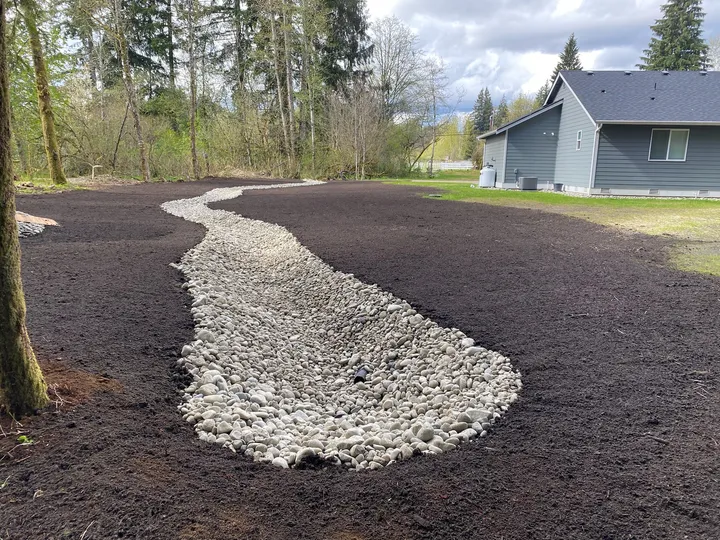
The short answer: most yard drainage problems come down to grade and soil. Water is landing somewhere it cannot leave, either because the ground slopes toward the house or because hardpan and compacted fill will not let it soak in. The fix is to give it a path out: regrade the surface, cut a swale, lay a French drain, or replace a culvert that is too small for the ditch feeding it.
Every spring we get the same calls from the same kinds of yards. The snow goes, the ground is still frozen a foot down, and two weeks of melt and rain have nowhere to go. A lawn in Newport turns to soup, a crawlspace across the line near Priest River takes on water, a driveway ditch on a bench lot overtops and cuts a channel through the gravel. None of this is bad luck. Water follows grade and soil, and both can be changed.
Why yards around Newport hold water
The ground here was laid down by glaciers and the Pend Oreille River, and it drains very differently depending on where you sit. Down near the river the soil is sand and silt. It soaks up water fast but sits on a high water table, so a low lawn can be wet from below no matter how well the surface drains. Up on the benches it is cobble and gravel over hardpan. The top foot takes water fine, then it hits the hardpan and runs sideways, often straight at a foundation. Hillside lots add bedrock close to the surface, which sheds water like a roof and dumps it on whatever sits below.
Layered on top of that are the usual construction mistakes, and we see all of them:
- Downspouts that dump against the foundation instead of well past it
- Lots graded flat, or graded toward the house, because the builder ran short on fill
- Driveways and walkways sloped so runoff lands at the garage door
- Culverts under a driveway that are undersized, crushed, or packed with silt
- Backfill around a foundation that was never compacted and has settled into a bowl
Compacted soil is the sneaky one. A yard that was the staging area for a house build has been driven over by every truck on the job. The top few inches look like lawn. Under that it is packed hard enough that water will not go in, so it sits.
What we look at before we dig
A drainage fix that is guessed at is a drainage fix you pay for twice. Before a machine comes out we walk the property, ideally while it is wet, and look at three things.
Slope and grade first. Where does the water enter the yard, where does it try to leave, and what is in the way. A hand level and a tape tell most of the story. Then soil. A test hole with the excavator bucket, or even a shovel, shows whether you have sand that drains, hardpan that does not, or a layer of one over the other. Then whatever is already in the ground: the culvert under the drive, the old drain tile at the footing, the ditch the county cut along the road. Half the time one of those is plugged or broken, and fixing it solves most of the problem.
From there the fix usually falls into one of four types, and often a combination of two.
French drains
A French drain is a trench with perforated pipe bedded in washed rock and wrapped in fabric. Water in the soil finds the rock, drops into the pipe, and runs downhill to daylight or a dry well. It is the right tool for a lawn that stays soggy, a wet spot at the base of a slope, or water seeping toward a basement wall.
We dig them with the Cat 303.5E2, which is narrow enough to trench along a foundation or between a house and a fence without tearing up the whole yard. The rock comes in with the tracked dump buggy, so nobody is running a wheelbarrow across soft ground. The parts that matter are fall (the pipe has to run downhill the entire way, which is harder than it sounds on a flat river-bottom lot) and an outlet that actually daylights somewhere lower than the problem.
Surface drains and catch basins
Where water comes off a hard surface like a driveway, a patio, or a shop apron, a French drain is the wrong answer because the water never enters the soil in the first place. A catch basin or channel drain set in the low spot collects it and a solid pipe carries it away. On sloped driveways in Newport and Oldtown we often pair a channel drain at the garage with a ditch and culvert at the road, so the water is handled at both ends.
Swales and regrading
Sometimes the answer is just dirt. A swale is a shallow, wide ditch, often lined with rock, that carries surface water across a yard to where it can leave. Regrading means reshaping the ground so it falls away from the house on every side and the low spot lands somewhere harmless. The compact track loader does most of this work. On a lot that was never properly finish graded, grading and leveling is the single most effective fix there is. A few inches of fall in the first ten feet from a foundation solves a lot of wet basements, and it costs less than any pipe.
Culvert replacement
If your driveway or private road floods, or the ditch above it turns into a pond, the culvert underneath is usually too small, crushed, or full of silt and pine needles. We dig it out, set a properly sized pipe with the right bedding, and rebuild the approach. Along SR 20 and the county roads north toward Usk, the culvert at the road is often the county’s, so we check who owns it before we touch it.
What ignoring it costs you
Standing water is expensive to ignore. Water against a foundation wall finds the cold joint and gets in, then freezes and pries. Uncontrolled runoff cuts channels through topsoil and takes lawn and fence posts with it. A low spot that holds water breeds mosquitoes all summer. A driveway that drains toward the garage turns to washboard and ruts, and you end up buying gravel every year to replace what washed away. Fixing the grade or adding a drain is cheaper than repairing any of those, and it only has to be done once.
How the season changes the job
Drainage work has a rhythm here. Spring thaw is when the problem is obvious and the ground is too soft to work without rutting it. Late spring through fall is when we can dig cleanly, and it is also when you have to remember where the water was. We ask for photos from the wet weeks, and we take our own if we get there in time. Fall is a good window to get a fix in before the ground freezes. What we will not do is trench frozen ground in January and pretend the fall in the pipe is right.
Getting your yard drained
If your lawn holds water every spring, or a basement wall weeps, we will come out, walk the lot, and tell you which of the fixes above you need and in what order. We install drainage systems throughout Pend Oreille County and across the line in Bonner County, including Priest River. Send a few photos of the wet spot through the estimate form and we will call back the same business day.
Want Corey to look at your ground?
Free written estimate after a site walk. Same-day callback.
Questions we get on the site walk
Will a French drain fix a wet basement?
Often, if the water is moving through the soil to the wall. A French drain along the footing intercepts it before it reaches the foundation. It will not help when the problem is a high water table pushing up from below, which is common on river-bottom lots near Newport. That needs a different approach, and the site walk tells us which one.
How do I know if my yard needs regrading or a drain?
Look at where the water sits. If it pools against the house or the lawn slopes toward it, that is a grade problem, and reshaping the dirt fixes it. If the grade looks fine but the ground stays soggy anyway, that is a soil problem, and a French drain or dry well gives the water somewhere to go.
Can you fix drainage in the spring when everything is wet?
We can diagnose it in spring, and that is the best time to see the problem. Digging in mud ruts the yard and the trench walls slump, so we usually schedule the work once the ground firms up, from late spring into fall. If water is actively getting into a house we can do a temporary fix sooner.
Why does my driveway culvert keep flooding?
Usually it is undersized for the ditch feeding it, or it is packed with silt, pine needles, and gravel pushed in by years of plowing. Sometimes a truck has crushed it. We dig it out, set a larger pipe at the right grade on proper bedding, and rebuild the approach so it holds.
Where does the water go once you drain it?
Somewhere lower than the problem, which is the whole trick. On a sloped lot it daylights at the low side of the property or into a roadside ditch. On a flat lot it may need a dry well, a rock pit dug below the wet zone. We confirm the outlet before we design the drain, because a drain with nowhere to empty is a long bathtub.