
Corey Davison · September 16, 2026 · Site prep
What Does Excavation Cost in Pend Oreille County?
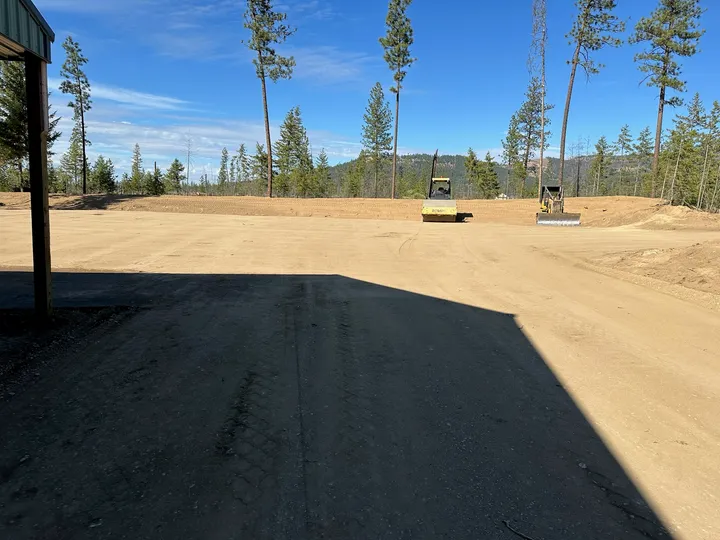
The short answer: excavation cost in Pend Oreille County depends on what the ground is made of, how we get a machine to it, how far the spoil has to travel, what has to be brought in, and how many machine hours all of that adds up to. Two lots the same size can price far apart because one is river sand and the other is hillside rock. We price from a site walk, never from a phone call.
We do not print dollar figures on this site, and we do not quote by the hour. Fuel, trucking, and gravel move with the seasons, and a number that was fair in May can be wrong by September. What stays the same is the list of things that move the price. Once you know those, you can look at any excavation estimate and tell whether it is complete.
The ground itself
Soil is the first thing we look at on a walk, and it is the factor that swings the estimate the most. Pend Oreille County has three kinds of ground, and they can all show up on one road.
River sand and silt
Down along the Pend Oreille River, through Newport, Usk, and Cusick, the river left sand and silt. It digs like butter. The bucket fills clean, the truck loads light, and a foundation hole goes fast. The catch is water. The table is high near the river, so a basement or a deep trench may hit it, and wet sand slumps, which means shoring or wider cuts. Sand also does not hold a steep slope, so a finished cut may need more room than the plans show.
Bench cobble and hardpan
Climb off the river bottom and the ground turns to glacial cobble and gravel sitting on hardpan. This is most of the buildable land in the county. The top foot digs fine. Below that the bucket fights fist-sized and head-sized rock, and the hardpan under it is dense enough that a mini excavator slows down noticeably. The good news is that a pad cut in bench gravel is stable and drains, so there is less base material to bring in. The trade-off is more machine time per yard of dig.
Hillside rock
On the slopes above the valley, bedrock can be inches below the duff. Sometimes it is fractured and comes out with a bucket and patience. Sometimes it needs a hydraulic hammer, and then a job that looked like two days becomes a week. We probe for rock on the walk, but rock does not always announce itself, which is why a good estimate says what happens if we find more than expected. Rock and hard dig excavation is its own line of work for that reason.
Access
The next question is how we get to the dig. A lot with a wide, firm approach off SR 20 lets us trailer the machine to the edge of the work and back a truck up to the spoil pile. A lot at the end of a narrow two-track through pines, or a backyard behind a house with a six-foot gate, does not.
Tight access is where the tracked dump buggy earns its keep. It carries material through spaces a truck cannot reach, but every trip it makes is machine time a truck would have done in one. Soft access adds cost too. If the driveway is mud in April, we either wait, mat it, or fix the access first, and all three show up on the estimate.
Haul distance
Spoil has to go somewhere. Topsoil we try to keep on site for the finish grade. Subsoil, cobble, and stumps often have to leave, and the price of leaving is the round trip. A lot near town where the spoil can be dumped a few miles away is a different job than one where each load rides forty minutes each way. The same goes for material coming in. The truck and the driver are working the whole time, whether the bed is full or empty.
On a lot of jobs we can shorten the haul by using the material on site: cobble from the foundation dig becomes driveway base, and clean fill goes into a low spot. That takes planning on the walk, but it can knock a lot of truck miles off the job.
Material coming in
Almost every job brings something in. Structural fill under a pad, crushed base under a driveway, drain rock around a foundation, bedding sand around a water line. What you need depends on what you have. A pad cut in clean bench gravel might need very little. A pad on river silt may need a foot or more of imported fill to carry a house, and that is trucks, material, and compaction time all stacked together.
We tell you on the estimate what material we expect to bring in and why, so you can see what part of the number is dirt we sell you and what part is work.
Machine time
Everything above adds up to hours on the machines, and that is the number underneath the number. A foundation dig in sand might be a day with the Cat 303.5E2. The same footprint in hardpan cobble might be two, and in rock, more. Grading a pad with the track loader, compacting lifts with the plate compactor, trenching utilities, and loading the truck each take their own time. When we walk a lot we are counting hours in our head, and the estimate is those hours plus the material and the hauling.
What the site walk changes
People sometimes ask why we insist on a walk before we will put a number on paper. This is why. On a walk we probe the soil with a bar or dig a test hole, check how the water moves, look at the approach, measure the haul, and find out where the spoil can go. Every one of those changes the estimate, sometimes by a lot. A lot in Cusick that looked flat and easy on the phone might have the water table two feet down. A lot on the hill above Newport that sounded like rock might be deep glacial gravel after all.
The walk also catches the things that are not on the plans yet: a septic drainfield that has to stay clear, a well that needs a setback, a power line over the only truck path, a neighbor’s fence a foot over the line. Finding those before the machine is on site is cheaper than finding them after.
What a written estimate should list
When you get an excavation estimate, look for all of the following:
- What is being dug, where, and to what depth or elevation
- What is assumed about the soil, and what happens if rock or water shows up
- Where the spoil goes and who hauls it
- What material is being brought in and roughly how much
- How access is being handled, including any mats or road repair
- Grading and topsoil replacement at the end
- What is not included, like permits, surveying, or another trade’s work
If two estimates differ a lot, the difference is usually in one of those lines, not in the machine rate. Ask.
Getting a number for your lot
The only honest way to price excavation is to stand on the ground. We do site preparation and every part of the earthwork under it from Newport up the river to Cusick, and we will walk your lot, probe it, and put a written estimate in your hand. The estimate form is the quickest way to get that started.
Want Corey to look at your ground?
Free written estimate after a site walk. Same-day callback.
Questions we get on the site walk
Why will you not give me a number over the phone?
Because the number would be a guess dressed up as a quote. We cannot tell from a description whether your lot is sand, cobble, or rock, whether the truck can reach the dig, or where the spoil can go. A site walk takes under an hour and turns those guesses into a written estimate you can hold us to.
What is the single biggest thing that changes the cost of excavation?
Soil. Sand and silt in the river bottom dig fast and load light. Cobble and hardpan on the benches dig slower and wear on the machine. Rock on the hillsides may need a hammer and can multiply the hours on the same footprint. Everything else on the list matters, but soil sets the baseline.
Does a bigger machine make excavation cheaper?
Only when the job is big enough to keep it busy. On most house lots a mini excavator like our Cat 303.5E2 gets into places a larger machine cannot, tears up less of the yard, and costs less to move. A large job with long hauls might justify a bigger machine, and we will say so on the walk.
Can I save money by clearing the lot myself first?
Sometimes, if you are careful. Felling and bucking trees you can handle yourself does cut our time. Where it backfires is stumps left in the pad area, brush piled where the truck needs to park, or topsoil pushed into a heap mixed with roots. Talk to us before you start so the work you do actually helps.
What should be listed on a written excavation estimate?
What is being dug and to what depth, what happens to the spoil, what material is coming in and roughly how much, how access is being handled, what is assumed about the soil, and what happens if rock or water shows up that was not expected. If the estimate is one number on a page, ask for the breakdown.