
Corey Davison · October 14, 2025 · Site prep
What Does an Excavating Company Do?
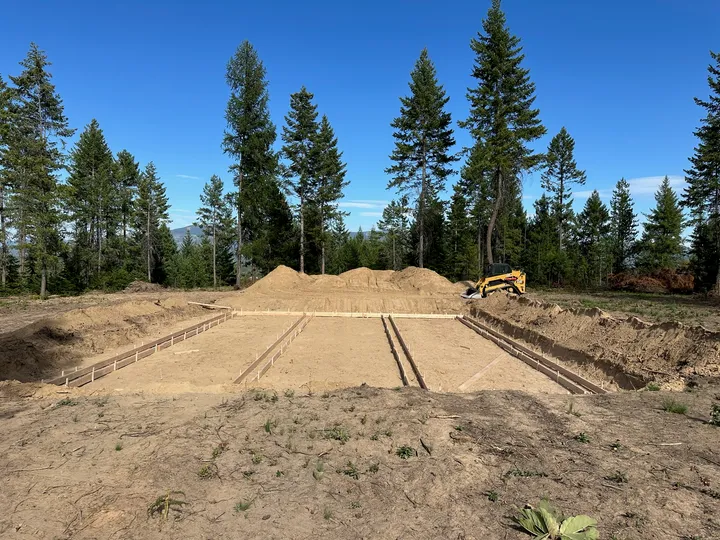
The short answer: an excavating company moves dirt and rock so something else can be built on it or in it. That covers clearing the lot, digging the foundation hole, trenching for water and power, building the driveway, shaping the ground so water drains, digging the septic system or a pond, and hauling material in and out. On a new home around Newport or Oldtown, we are usually the first trade on the site and one of the last.
People hear “excavating” and picture a big machine digging a big hole. The hole is part of it. Most of the job, though, is deciding where the dirt should end up, what should be under the things you are about to build, and where the water is going to go once you have changed the shape of the ground. Here is what that looks like, trade by trade, on the lots we work in Pend Oreille County and North Idaho.
Site preparation
Before a house, a shop, or a driveway can go in, the ground has to be made ready for it. That means taking off the trees and brush, stripping the topsoil and stockpiling it for later, cutting the high spots, filling the low spots, and compacting what the building will sit on. On a wooded lot off US-2 that can be a week of work before anyone sees a foundation stake.
Site preparation is the hub everything else hangs on. Get the pad elevation wrong and the septic will not flow, the driveway will be too steep, or the garage floor will sit below the yard. We set the pad from the plans and the septic design together, not one after the other.
Foundation excavation
Once the pad is set and the corners are staked, we dig the hole for the footings, the stem walls, or the full basement. The digging itself is measurement work. The bottom has to be at the depth the plans call for, flat and undisturbed, with enough room outside the walls for forms and drain rock. A basement in bench cobble digs differently than a crawlspace in river sand, and a hillside lot with rock near the surface may need a hammer on the excavator before it needs a bucket.
After the concrete crew pours and strips, we come back to backfill against the walls and compact in lifts so the ground does not settle into a trough along the foundation and pull water toward it. Foundation excavation and backfill are two visits, and both matter.
Utility trenching
Water from the well or the district main, power from the pole or the transformer, the septic line from the house to the tank, and often conduit for internet all run in trenches. Each has its own depth. Water lines here have to be below frost, which puts them deeper than most people expect. Power has its own rules from the utility. Where trenches cross, the separation between them matters.
We dig with the 303.5E2, which keeps the trench narrow and the yard mostly intact, and we backfill with the right bedding around the pipe so a rock does not crush a water line the first winter. On most new home lots we trench utilities after the foundation is in and before the driveway goes down, so we are not cutting a finished drive.
Driveways and private roads
A driveway is a small road, and it fails for the same reasons roads fail: a weak base, no crown, and nowhere for water to go. Building one means stripping the topsoil off the route, shaping the subgrade, laying a base course that suits the ground, and finishing with a top course that packs tight and plows clean. Long rural drives off SR 20 or ID-41 add ditches, culverts at low points, and sometimes a turnout.
Drainage and culverts
Every time we move dirt we change where water goes, so drainage is part of every job and sometimes the whole job. That includes French drains along a foundation, swales across a yard, catch basins at a shop apron, and culverts under a driveway where a ditch has to cross. On our benches the top foot of gravel over hardpan sends water sideways toward houses, and near the river the water table is close to the surface. Both call for a plan.
Septic systems
Most lots outside town are on septic. A designer lays out the system and the health district permits it. We dig the tank hole and the drainfield trenches to the approved drawing, set the tank, bed the pipe, and cover it after inspection. The drainfield is where the soil really matters, and the designer’s test holes are often the first thing we dig on a lot.
Ponds, hard digs, and hauling
Some jobs are pure earthmoving. A stock pond or a fire pond, a cut into a hillside for a shop pad, breaking and removing rock that turned up where the plans said dirt. Others are logistics: bringing in gravel, hauling out stumps and spoil, or taking down an old shed so something new can go up. The dump truck and the dump buggy do a lot of miles on those.
Why local matters on this ground
A machine is a machine, but the ground is not the same everywhere, and the difference shows up in the bid and the finished job. Around Newport, Oldtown, and Priest River the soil changes in a few hundred feet: sand and silt in the river bottom, cobble and gravel over hardpan on the benches, and rock outcrops on the hillsides. Winter frost goes deep, and spring thaw turns anything unpaved to mud for weeks.
Knowing that changes decisions. It changes how deep a water line goes, whether a driveway gets a full base or a thin one, whether a basement is even a good idea on a given lot, and which month a job should start. It also means knowing which office to call. On the Washington side that is Pend Oreille County Community Development for land use and grading and Northeast Tri County Health District for septic. Across the line in Bonner County it is the county planning office and Panhandle Health District. We will tell you on the site walk which rules apply to your lot.
What to look for when hiring an excavator
The old version of this post had a checklist and it still holds. Look for someone who has worked the soil you have, who is licensed and insured in the state you are building in, who runs equipment that is sized for your lot rather than too big or too small for it, and who gives you a written estimate that lists what is included. Ask how they handle rock if it shows up. Ask who calls for locates before they dig. Ask what happens to the topsoil.
Corey runs the machines on our jobs himself, so the person who walks your lot is the person in the cab. That is worth something when a decision has to be made with the bucket in the ground.
Starting your project
If you are planning a build in Newport, Oldtown, or anywhere between Deer Park and Spirit Lake, the best first step is a site walk. We look at the ground, the water, and the access, and we tell you what the job involves before you commit to anything. The estimate form is the quickest way to get on the schedule.
Want Corey to look at your ground?
Free written estimate after a site walk. Same-day callback.
Questions we get on the site walk
Is an excavating company the same as a general contractor?
No. A general contractor runs the whole build and hires the trades. An excavating contractor is one of those trades, responsible for the earthwork: clearing, digging, grading, trenching, and hauling. On a lot of custom homes around Newport the owner acts as their own general and hires us directly, which works fine as long as the sequence is planned.
When does the excavator show up on a new home build?
First, and then again several times. We clear and rough grade the lot before anything else happens, dig the foundation before the concrete crew arrives, come back to backfill after the walls are poured, trench utilities before the driveway goes in, and finish grade at the end. Each visit depends on another trade being done.
What machines does an excavating company use on a house lot?
For residential work the core set is a mini excavator, a compact track loader, and a dump truck. Ours is a Cat 303.5E2, a track loader for grading and moving material, a tracked dump buggy for tight or soft spots, a dump truck for hauling, and a plate compactor for trench backfill and pads.
Do excavating contractors pull the permits?
The septic permit is issued to the property through a designer and the health district, and the building permit is the owner's or general contractor's. We work to the approved drawings and coordinate inspections for our part. We will tell you on the site walk which offices are involved for your lot so nothing gets missed.
Can you do just one part, like a driveway or a trench?
Yes. Plenty of our work is a single job on an existing property: a gravel driveway, a water line trench, a drainage fix, or a pad for a shop. The same machines and the same attention to soil and water apply. The site walk is shorter, but we still do one before we quote.