
Corey Davison · October 7, 2026 · Driveways and roads
What a Gravel Driveway Costs to Build in Northeast Washington
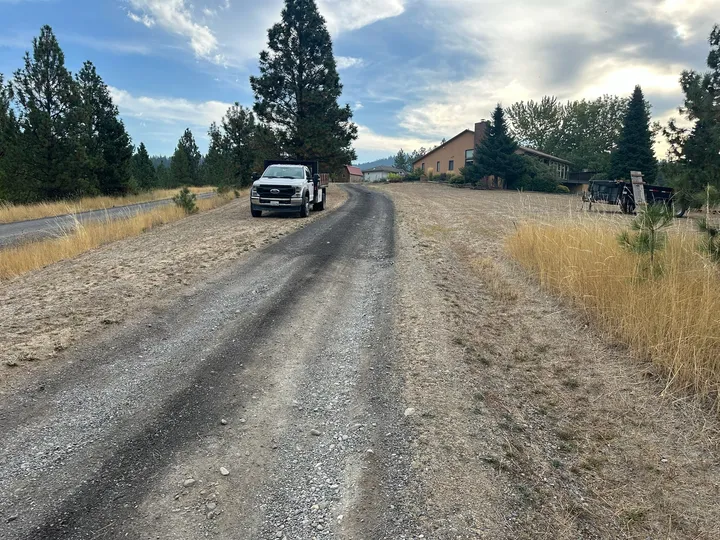
The short answer: the cost of a gravel driveway is set by its length, how deep the base has to go for the ground it sits on, whether it is crowned and ditched, how many culverts it needs, what material goes down, and whether it has to survive a plow. There is no per-foot number that survives contact with a real lot. We measure it and probe the ground before we put a number on paper.
We do not print dollar figures, and we do not quote gravel driveways by the foot. Gravel and trucking prices move, and a per-foot figure hides the thing that actually decides whether a driveway lasts, which is the ground under it. What we can do is walk through everything that moves the number, so you can read any estimate and know whether it is a driveway or a pile of rock.
Length
Length is the obvious one, and it matters more than the arithmetic suggests. A long rural driveway off a county road outside Deer Park is more base, more top course, more truck trips, and more grading time, but it is also more chances to cross a low spot, more ditch to cut, and more plow to push. When we measure, we include the approach at the road, the turnaround or parking pad at the house, and any turnout on a single-lane run, because those are driveway too.
Base depth and what is under it
This is the factor that separates a driveway that lasts from one you rebuild in three years, and it is the one a per-foot price cannot see.
A driveway is only as strong as its subgrade. Around here that subgrade is one of three things. On the benches it is glacial cobble and gravel over hardpan, which is about the best driveway ground there is. Strip the topsoil, shape it, and a modest base course on top is enough. In the river bottom near Priest River or along the Pend Oreille it is sand and silt, which is soft when wet and pumps under a loaded truck. That ground needs a deeper base, sometimes fabric under it, to keep the gravel from disappearing into the mud. On a hillside, rock near the surface may need cutting to get a drivable grade, and the fill on the low side has to be compacted in lifts or it will slump.
We probe the route on the site walk to see which one you have. The base depth on the estimate comes from that, and a good estimate says what it assumes and what happens if the ground is softer than expected once the topsoil is off.
Crown
A crown is the slight hump down the center of a driveway so water runs off both sides instead of down the middle. It is the cheapest thing on this list and the most often skipped. Without a crown, every rain and every thaw turns the wheel tracks into channels, the channels into ruts, and the ruts into a creek bed. We shape the crown into the base with the compact track loader, then hold it in the top course, and we check it again after the plate compactor has done its work.
Ditches and culverts
Once water leaves the crown, it needs somewhere to go. On a flat bench that might be nothing more than a shallow swale along one side. On a sloped run it means a ditch on the uphill side, cut deep enough to carry spring melt and lined with rock where it is steep. Anywhere the driveway crosses a ditch, a swale, or a seasonal wet spot, it needs a culvert sized for the water and bedded so it does not crush under the truck.
The culvert at the road is the one people forget. Where your approach meets a county road, the roadside ditch has to pass under it, and the county may have a say in the pipe size and the approach. On the Washington side, check with Pend Oreille County or Spokane County depending on which side of the line Deer Park puts you on. We will tell you on the walk who to ask.
Material
Gravel is not one thing. A driveway that lasts is two layers of different rock doing different jobs.
The base is coarse: pit run or a larger crushed rock with fines that locks together under compaction and spreads the load over the subgrade. The top course is crushed three-quarter minus or similar, angular rock with enough fines to pack tight, hold a crown, and give a surface that drives and plows smooth. Round river gravel looks nice and never packs, so it rolls under tires and migrates into the ditch. Recycled asphalt millings are another top course option where they are available.
How much of each you need is the base depth and the length, and it comes to the lot in our dump truck. Where the truck cannot reach, the tracked dump buggy carries it in, which adds time. The estimate should say what rock is going down and roughly how much, so you can see the material as a line separate from the work.
Plow season
A driveway in Northeast Washington gets plowed, and plowing is hard on gravel. The blade catches the crown, scrapes the top course into the ditch, and finds every rock that was not packed. A driveway built for plowing has a firm top course compacted in place, a crown that is real but not sharp, and edges that are defined so the plow driver can find them under a foot of snow. We also set culvert ends and any markers back from the edge so the plow does not take them.
Spring is the other half of plow season. When the frost goes out, a thin driveway on soft subgrade turns to mud for a few weeks, and gravel laid on it during that window sinks. We build driveways from late spring through fall on firm ground, and we would rather push a job a month than lay base in April mud.
Why cheap driveways fail
The cheap driveway is a load of gravel dumped on the topsoil and spread with a blade. It looks fine in August. Then the first hard rain moves the fines, the first thaw turns the topsoil under it to soup, the gravel sinks into the mud, and by the second spring there are two ruts with grass growing between them. The owner buys another load, spreads it on top, and the cycle repeats. Over ten years that is a lot of gravel, and the driveway is never good.
The expensive-looking driveway is the one where the topsoil came off, the subgrade was shaped and compacted, the base went down in a lift you could feel under your boots, the crown and ditches were cut, the culverts were set, and the top course was compacted rather than spread. It costs more once, and then you top it every few years and it stays a driveway.
What a written estimate should list
When you compare bids for a gravel driveway, look for these on paper:
- Length and width, including the approach, turnaround, and any turnouts
- Topsoil stripping and where the topsoil goes
- Base material, depth, and what is assumed about the subgrade
- Fabric, if the ground calls for it
- Top course material and depth
- Crown, ditches, and rock lining where needed
- Culverts, with size and location
- Compaction of each lift
- Who handles the road approach and any permit for it
If an estimate is one number with no breakdown, you cannot tell whether it includes a base or just a top course, and that is the whole difference.
Getting a number for your driveway
The only way to price a gravel driveway honestly is to walk the route, probe the ground, and look at where the water goes. We build driveways and private roads from Deer Park up through Newport and across the line to Priest River, and we will put every item above in writing. The estimate form is the quickest way to get on the list before the next plow season.
Want Corey to look at your ground?
Free written estimate after a site walk. Same-day callback.
Questions we get on the site walk
How long does a gravel driveway last?
A driveway with a proper base, a crown, and working ditches lasts for decades with a fresh top course every few years. A driveway that is gravel dumped on topsoil lasts until the second spring. The difference is almost entirely in what is under the gravel and where the water goes, which is why those items are most of the estimate.
What kind of gravel should a driveway be?
Two layers. A coarse base of pit run or larger crushed rock that locks together and carries the load, then a top course of crushed three-quarter minus that packs tight and gives a smooth surface. Round river gravel rolls under tires and never packs, so we do not use it as a driving surface.
Do I need a culvert for my driveway?
If the driveway crosses a ditch, a swale, or any low spot where water runs in spring, yes. The most common one is at the road, where the county ditch has to pass under your approach. Skipping it means the driveway becomes the dam, and the water goes over or through it every thaw.
Why does my driveway wash out every spring?
Usually one of three things: no crown so water runs down the middle instead of off the sides, no ditch so it has nowhere to go once it reaches the edge, or a culvert that is too small or plugged. Sometimes all three. Fixing the water problem is cheaper than adding gravel every year to replace what it carried off.
Can a gravel driveway be built in winter?
Sometimes, on frozen ground, if the route is already cleared and the material is available. What we avoid is building the base during spring thaw when the subgrade is mud, because gravel placed on mud sinks into it and is gone by summer. Late spring through fall is the normal window.